Tel: 0129-4001010 Phone: +91 730 321 5033
Email: cs@absoluteveritas.com

BIS Certification for Hinges in India: QCO, Standards, Process & Benefits
Table of Content
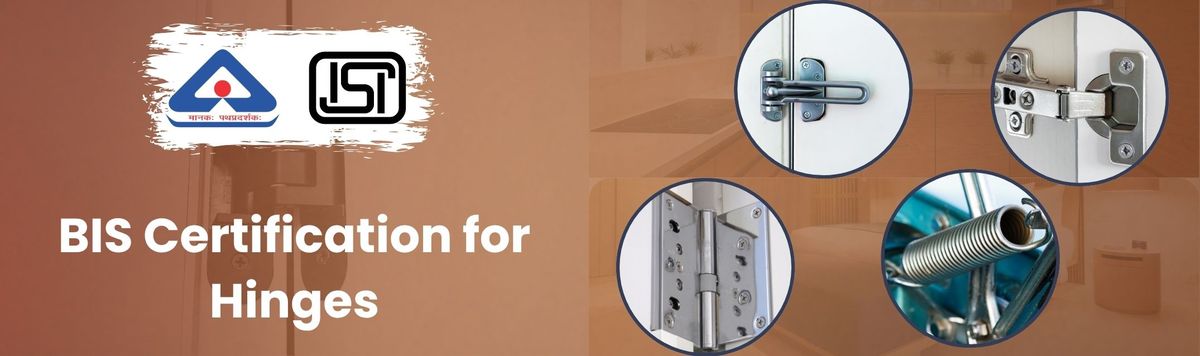
The Government of India has made BIS certification mandatory for various categories of hinges through the Hinges Quality Control Order. The order aims to ensure that hinges sold, imported, or distributed in India meet the prescribed safety, durability, material, dimensional, and performance requirements specified by the Bureau of Indian Standards (BIS).
As per the Hinges QCO, manufacturers and importers of covered hinge products must obtain BIS certification and use the ISI Mark before placing these products in the Indian market. The order applies to multiple hinge categories including steel butt hinges, stainless steel butt hinges, cabinet hinges, double-acting spring hinges, steel back flap hinges, continuous piano hinges, parliament hinges, tee and strap hinges, and non-ferrous metal butt hinges.
For domestic manufacturers, BIS certification is granted under the ISI Mark Certification Scheme. For foreign manufacturers exporting hinges to India, certification is obtained through the Foreign Manufacturers Certification Scheme (FMCS).
Why Is BIS Certification for Hinges Important?
BIS certification ensures that hinges conform to the applicable Indian Standard and are suitable for use in doors, cabinets, furniture, gates, windows, construction fittings, and hardware applications. Since hinges are critical functional components, poor-quality hinges may affect safety, durability, alignment, load-bearing strength, and product reliability.
With the implementation of the Hinges QCO, covered hinge products cannot be manufactured, imported, sold, or distributed in India unless they bear the BIS Standard Mark under a valid BIS licence. Non-compliance may lead to penalties under the Bureau of Indian Standards Act, 2016.
BIS Certification Compliance for Hinges
The Hinges Quality Control Order requires covered hinge products to conform to the applicable Indian Standard and bear the Standard Mark under a BIS licence. The certification process involves application filing, documentation, product testing, factory inspection, review by BIS, and grant of licence.
Manufacturers must identify the correct Indian Standard based on hinge type and product design. Each hinge category has a separate Indian Standard, and a separate BIS scope may be required depending on the product covered.
Products Covered Under Hinges QCO
The Hinges QCO covers the following hinge categories and applicable Indian Standards:
|
Goods or Articles |
Indian Standard |
Title of Indian Standard |
|
Hinges |
IS 12817:2020 |
|
|
IS 18297:2023 |
||
|
IS 453:1993 |
||
|
IS 3843:1995 |
||
|
IS 3818:1992 |
||
|
IS 362:1991 |
||
|
IS 206:2010 |
||
|
IS 205:1992 |
||
|
IS 1341:2018 |
Product Details
IS 12817:2020 — Stainless Steel Butt Hinges
Stainless steel butt hinges are commonly used for doors, cabinets, furniture, and architectural hardware where corrosion resistance and durability are important. Under the Hinges QCO, these products must comply with IS 12817:2020 and bear the BIS Standard Mark.
IS 18297:2023 — Cabinet Hinges
Cabinet hinges are used in furniture, modular kitchens, wardrobes, storage cabinets, and similar applications. BIS certification helps ensure proper performance, strength, and durability as per IS 18297:2023.
IS 453:1993 — Double-Acting Spring Hinges
Double-acting spring hinges allow doors to swing in both directions and return to a closed position. These hinges are used in commercial, industrial, and interior door applications where automatic return movement is required.
IS 3843:1995 — Steel Back Flap Hinges
Steel back flap hinges are used in wooden boxes, furniture fittings, foldable components, and hardware applications. Compliance with IS 3843:1995 ensures that the product meets the prescribed quality and construction requirements.
IS 3818:1992 — Continuous Piano Hinges
Continuous piano hinges run along the full length of a door, panel, box, or lid and distribute load evenly. They are used in furniture, enclosures, cabinets, and industrial hardware applications.
IS 362:1991 — Parliament Hinges
Parliament hinges are used where doors or shutters need to open wide away from the frame. BIS certification under IS 362:1991 is required for covered parliament hinge products under the Hinges QCO.
IS 206:2010 — Tee and Strap Hinges
Tee and strap hinges are commonly used for gates, doors, shutters, boxes, and general building hardware. These hinges are covered under IS 206:2010 and require BIS certification for sale in the Indian market.
IS 205:1992 — Non-Ferrous Metal Butt Hinges
Non-ferrous metal butt hinges are used where corrosion resistance, appearance, and non-ferrous material properties are required. These products must conform to IS 205:1992 under the Hinges QCO.
IS 1341:2018 — Steel Butt Hinges
Steel butt hinges are widely used in doors, windows, furniture, cabinets, and building hardware. Under the Hinges QCO, steel butt hinges must comply with IS 1341:2018 and display the BIS Standard Mark.
Process to Obtain BIS Certification for Hinges
Obtaining BIS certification for hinges requires compliance with the applicable Indian Standard and successful completion of BIS conformity assessment requirements. The process applies to both Indian manufacturers and foreign manufacturers exporting hinges to India.
Steps to Obtain BIS Certification for Hinges:
-
Identify the applicable Indian Standard based on hinge type.
-
Prepare required documents, manufacturing details, and product specifications.
-
File the BIS application under the applicable certification scheme.
-
Submit samples for testing at a BIS-recognized laboratory.
-
Complete factory inspection by BIS officials.
-
Resolve any technical or documentation queries raised by BIS.
-
Obtain BIS licence and start marking products with the ISI Mark.
About Absolute Veritas
Absolute Veritas is a trusted BIS certification and regulatory compliance consultancy supporting Indian and foreign manufacturers with BIS ISI Mark certification, FMCS certification, product testing, documentation, factory audit coordination, and post-certification compliance.
Our team assists hinge manufacturers in identifying the correct Indian Standard, preparing application documents, coordinating BIS-recognized lab testing, handling BIS queries, and completing the certification process efficiently.
For any questions regarding BIS certification for hinges, please contact us at cs@absoluteveritas.com
Frequently Asked Questions (FAQ)
Is BIS certification mandatory for hinges in India?
Yes, BIS certification is mandatory for hinge products covered under the Hinges Quality Control Order. Such products must bear the ISI Mark before being sold, imported, or distributed in India.
Which hinge products are covered under the Hinges QCO?
The QCO covers stainless steel butt hinges, cabinet hinges, double-acting spring hinges, steel back flap hinges, continuous piano hinges, parliament hinges, tee and strap hinges, non-ferrous metal butt hinges, and steel butt hinges.
Is BIS FMCS certification required for imported hinges?
Yes, foreign manufacturers exporting covered hinges to India must obtain BIS certification under the Foreign Manufacturers Certification Scheme before selling or importing the products into India.
Can one BIS licence cover all types of hinges?
Not necessarily. Since different hinge categories are covered under different Indian Standards, the licence scope depends on the applicable standard, product category, and BIS approval.
Who can help with BIS certification for hinges?
Absolute Veritas can support manufacturers with application filing, documentation, product testing coordination, BIS audit support, and complete certification assistance for hinge products.
Share this Post
 LinkedIn
 WhatsApp
 Facebook
CONTACT US

 ❮
❮