Tel: 0129-4001010 Phone: +91 730 321 5033
Email: cs@absoluteveritas.com

Transition Facilitation (Quality Control) Order, 2026: New BIS Compliance Pathway for Manufacturers
Published Date: 01 July 2026
Table of Contents
- 1. Overview
- 2. What Does the Transition Facilitation Order Introduce?
- 3. Which Quality Control Orders Are Covered
- 4. Eligibility and the Implementation Committee
- 5. Important Guidance for Manufacturers and Importers
- 6. Effective Date and Validity
- 7. How This Order Benefits Businesses
- 8. Steps Businesses Should Take Now
- 9. Common Mistakes to Avoid
- 10. How Absolute Veritas Supports Businesses
- 11. Frequently Asked Questions
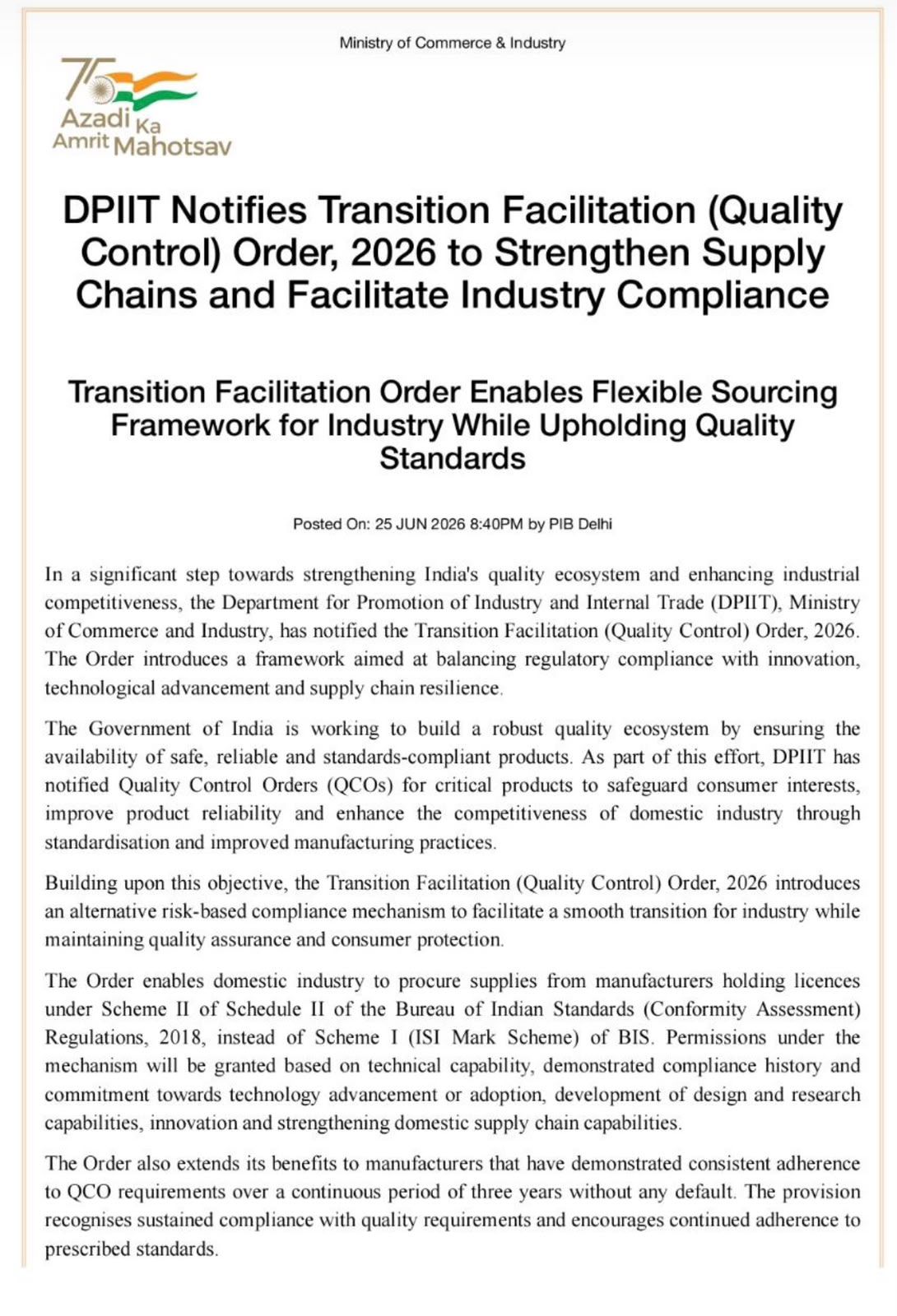
Manufacturers dealing with BIS-covered products have a new compliance option to work with. The Department for Promotion of Industry and Internal Trade (DPIIT), Ministry of Commerce and Industry, has notified the Transition Facilitation (Quality Control) Order, 2026, published in the Official Gazette as S.O. 3417(E) on 25 June 2026.
In plain terms, the Order gives eligible companies a second, government-approved route to keep supplying products under specified Quality Control Orders (QCOs) — by sourcing from BIS-licensed manufacturers under Scheme-II — while their own certification is still being processed. It doesn't relax any quality standard; it simply removes a common bottleneck. If your business handles products under any of the ten notified QCOs, or is currently working through ISI Mark Certification, this is worth building into your compliance planning right away.
At Absolute Veritas, we work with manufacturers, importers, and brands on BIS Certification, QCO compliance, documentation, and regulatory coordination across India — and we've broken down exactly what this Order means for you below.
Overview
India's QCO framework has grown fast since 2019, pulling in everything from toys and footwear to electrical appliances, furniture, and hinges under mandatory BIS certification. That pace hasn't always matched what's happening on the ground — many manufacturers have run into a genuine shortage of certified suppliers and supply chain gaps that slow everything down.
The Transition Facilitation (Quality Control) Order, 2026 was issued under Section 16 read with Section 25(3) of the Bureau of Indian Standards Act, 2016, following consultation with the Bureau. It's important to be clear about what this Order does and doesn't do — goods must still meet the applicable Indian Standard and carry the Standard Mark. What changes is where an eligible company can source certified product from while it works toward its own ISI Mark certification.
What Does the Transition Facilitation Order Introduce?
| Provision | Details |
|---|---|
| Alternative Sourcing Route | Eligible companies can now procure QCO-covered goods from manufacturers holding a valid BIS Scheme-II licence, instead of depending solely on their own Scheme-I (ISI Mark) certification while it's still in process. |
| Standard Mark Still Mandatory | Nothing about the quality bar changes here. Every product supplied under this route must still meet the corresponding Indian Standard and carry the BIS Standard Mark under a valid Scheme-II licence — this is a sourcing flexibility, not a shortcut on quality. |
| Permission-Based Access | The Scheme-II licence route under this Order only applies to companies that DPIIT has specifically approved — it isn't automatic or self-declared. |
| Risk-Based Assessment | Approval comes from an actual evaluation by the Implementation Committee, not just from submitting the right paperwork. |
| Continued Market Surveillance | BIS, working with DPIIT, will keep verifying — directly or through notified agencies — that supplied goods continue to meet the applicable Indian Standards. |
Which Quality Control Orders Are Covered
The Schedule to the Order lists ten notified QCOs where this transition facilitation currently applies. Click through to any product category below for the detailed BIS certification requirements specific to that product:
| S No. | Quality Control Order | Date of Implementation |
|---|---|---|
| 1 | Toys (Quality Control) Order, 2020 | 01 Jan 2021 |
| 2 | Personal Protective Equipment – Footwear (Quality Control) Order, 2020 | 01 Jan 2022 |
| 3 | Air Conditioner and its related Parts, Hermetic Compressor and Temperature Sensing Controls (Quality Control) Order, 2019 | 01 Oct 2023 |
| 4 | Footwear made from All Rubber and All Polymeric Material and its Components (Quality Control) Order, 2024 | 01 Aug 2024 |
| 5 | Footwear made from Leather and Other Materials (Quality Control) Order, 2024 | 01 Aug 2024 |
| 6 | Electrical Appliance for Domestic Water Heating (Quality Control) Order, 2025 | 01 Mar 2025 |
| 7 | Electrical Appliance for Domestic Clothes Washing (Quality Control) Order, 2024 | 01 Apr 2025 |
| 8 | Hinges (Quality Control) Order, 2025 | 01 Jul 2025 |
| 9 | Furniture (Quality Control) Order, 2025 | 13 Feb 2026 |
| 10 | Safety of Household, Commercial and Similar Electrical Appliances (Quality Control) Order, 2026 | 01 Oct 2026 |
If your product falls under any of these ten QCOs, this Order is directly relevant to your BIS compliance planning — check the specific product page above for the exact standards and certification steps that apply to you.
Eligibility and the Implementation Committee
Permission under this Order isn't handed out on request. DPIIT can grant it only to a company incorporated under the Companies Act, 2013, and only after a proper assessment by an Implementation Committee set up specifically for this purpose. The Committee is chaired by an Additional/Joint Secretary of DPIIT and includes representatives from the Department of Consumer Affairs, the Department of Commerce, the Directorate General of Foreign Trade, and the Bureau of Indian Standards (BIS).
Here's what the Committee actually looks at when evaluating an applicant:
- Technical capability and real, demonstrated manufacturing experience
- Quality assurance across the supply chain, including control over design and manufacturing
- Track record and integrity of past compliance conduct
- Commitment to building supply chain capability in India through technology adoption, design capability, or R&D
- Continuous, unbroken compliance with the relevant QCO for at least three years
- Any other factor the Committee considers relevant to the assessment
The Committee can draw on documents, declarations, certifications, and undertakings submitted by the applicant, and it may also engage directly with the company as part of the evaluation — so this isn't a purely paper-based process.
Official Source Documents
This article is based on the official notification published by the Department for Promotion of Industry and Internal Trade (DPIIT), Ministry of Commerce and Industry.
Gazette Notification – S.O. 3417(E), dated 25 June 2026:
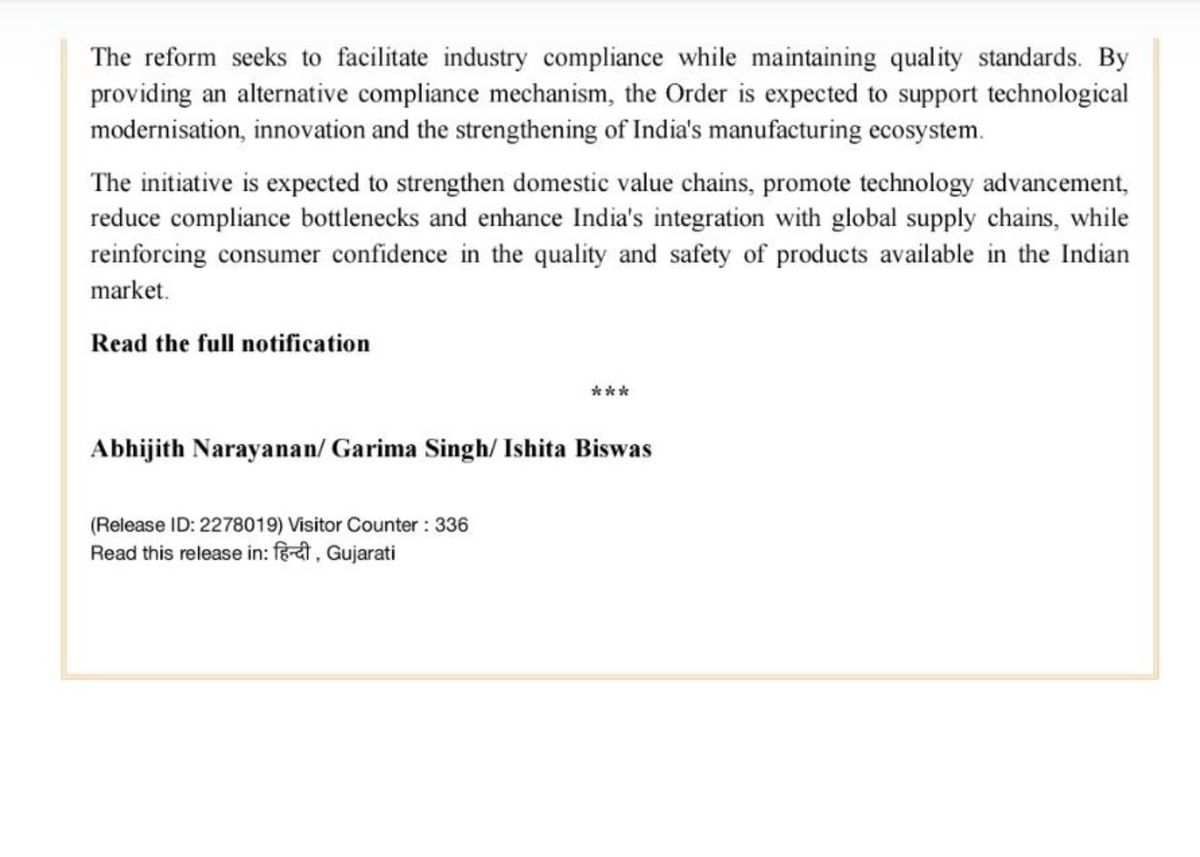
PIB Press Release, DPIIT, 25 June 2026
Important Guidance for Manufacturers and Importers
A few things worth keeping in mind before you rely on this route:
- Permission comes with conditions attached — the Government can suspend, modify, or withdraw it if those conditions aren't met
- False declarations or non-conforming products can get permission pulled immediately, though you'll get an opportunity to be heard first
- This facilitation is a bridge, not a substitute — you still need to keep progressing your own BIS Scheme-II licence application in parallel
- Whoever you source from must themselves hold a valid, active Scheme-II licence for the relevant product
- Keep your documentation airtight — BIS market surveillance checks will expect complete records
Effective Date and Validity
The Order came into force on 25 June 2026, the date it was published in the Official Gazette.
- Application window: 24 months from the date of commencement
- Order validity: 5 years from commencement, unless the Central Government extends it by Gazette notification
- Existing permissions: Continue for their approved duration even after the Order lapses, unless suspended, modified, or withdrawn earlier
DPIIT is expected to issue detailed application procedures, documentation formats, and eligibility guidelines separately, on its website (dpiit.gov.in) — worth keeping an eye on if you plan to apply.
How This Order Benefits Businesses
- Keeps your supply moving while your own BIS Scheme-II certification is still being processed
- Eases the compliance burden created by limited certified sources or supply chain bottlenecks
- Fast-tracks recognition for companies with a genuine three-year compliance track record
- Encourages investment in domestic manufacturing, design, and R&D capability
- Keeps consumer protection intact through mandatory market surveillance
- Gives you a clear, time-bound, government-sanctioned pathway instead of an informal workaround
Steps Businesses Should Take Now
- Check whether your product category falls under one of the ten QCOs listed in the Schedule above
- Review where your current BIS Scheme-II certification stands and what timeline you're looking at
- Start compiling the technical documentation, compliance history, and quality assurance records the Implementation Committee will assess
- If you intend to apply under this Order, identify a sourcing partner that already holds a valid Scheme-II licence for your product
- Keep progressing your own BIS certification in parallel — remember, this facilitation is time-bound
- Watch DPIIT's website for the detailed application guidelines once they're released
Common Mistakes to Avoid
Based on the provisions in the Order, companies planning to rely on this facilitation route should be careful to avoid the following:
- Assuming the Scheme-II sourcing route allows open-market supply — it applies only within the specific, DPIIT-permitted arrangement, not as a general alternative to holding your own licence
- Treating this facilitation as a substitute for pursuing full BIS Scheme-II certification, rather than a transitional bridge while that application progresses
- Sourcing from a manufacturer without independently confirming their Scheme-II licence is currently valid and active for the specific product
- Overlooking the three-year clean compliance history factor where it applies to your own risk assessment by the Implementation Committee
- Waiting until close to the 24-month application deadline to apply, leaving no buffer for document preparation or Committee review
- Assuming permission, once granted, is permanent — it remains conditional on continued conformity and can be suspended, modified, or withdrawn after a hearing
- Letting documentation lapse — BIS market surveillance checks will expect complete, current records at any point
How Absolute Veritas Supports Businesses
Absolute Veritas provides hands-on support for BIS Certification, QCO compliance, documentation, and regulatory coordination across India — so you're not navigating this alone.
Here's how our team can help:
- Eligibility assessment for the Transition Facilitation Order
- Compilation of technical, compliance, and quality assurance documentation
- BIS Scheme-II Licence application and progression
- BIS ISI Renewal and AMC Services
- ISI Mark Certification and Registration
- FMCS – Foreign Manufacturer Certification Services
- BIS Licence Renewal and Validity Management
- Market surveillance and audit readiness support
- Regulatory liaison and DPIIT guideline tracking
We help manufacturers, importers, and brands figure out exactly where the Transition Facilitation Order applies to their products, and make sure their long-term BIS/ISI certification and FMCS plans stay on track alongside it — not sidelined by it.
Need expert support to assess eligibility under the Transition Facilitation Order or to progress your BIS Scheme-II licence?
Connect with Absolute Veritas for professional guidance on QCO compliance, ISI Mark certification, FMCS, and regulatory compliance across India.
Frequently Asked Questions (FAQ)
What is the Transition Facilitation (Quality Control) Order, 2026?
It's an order notified by DPIIT on 25 June 2026 that lets eligible companies supply QCO-covered products sourced from BIS Scheme-II licensed manufacturers, while their own BIS certification is still in progress. All goods must still meet the applicable Indian Standard and carry the Standard Mark.
Which products are covered under this Order?
Ten QCOs are currently covered, spanning toys, footwear, air conditioners, furniture, hinges, water heaters, washing machines, and household electrical appliances. See the full list with product-specific links in the table above.
Who can apply for permission under this Order?
Only companies incorporated under the Companies Act, 2013 can apply. DPIIT grants permission based on a risk assessment carried out by a dedicated Implementation Committee.
Does this Order remove the need for BIS certification?
No — the Order doesn't relax any quality requirement. Products supplied under this route still need to conform to the applicable Indian Standard and carry the BIS Standard Mark under a valid Scheme-II licence. Companies must also keep progressing their own ISI Mark certification.
How long can businesses apply under this Order?
Applications are accepted for 24 months from the date the Order came into force. The Order itself stays valid for five years from commencement unless the Central Government extends it.
What happens if a business doesn't complete migration within the facilitation window?
The facilitation route is time-bound — permission stays valid for the term granted, but businesses are expected to keep progressing toward independent BIS Scheme-II certification in parallel rather than relying on this route indefinitely.
How can Absolute Veritas help with the Transition Facilitation Order?
Absolute Veritas helps businesses assess eligibility, pull together the technical and compliance documentation the Implementation Committee will evaluate, and simultaneously progress their BIS Scheme-II licence — so your long-term compliance isn't riding entirely on the transition window.
BIS BLOGS
.png)
Guide to BIS CRS Registration for Products in India
The Bureau of Indian Standards (BIS) and its Compulsory Registration Scheme (CRS) play a vital role in ensuring the quality...
Read More.png)
BIS Registration Renewal: A Complete Guide
The BIS CRS (Bureau of Indian Standards/Compulsory Registration Scheme) outlines mandatory requirements for both domestic...
Read More
BIS CRS Labelling Guidelines
Under the BIS-CRS Labelling Scheme, which currently covers 78 mandatory product categories, all products must receive...
Read More%20Compliance%20Needed%20for%20Analog%20CCTV%20Cameras.png)
No Essential Requirement Compliance Needed for Analog CCTV Cameras
As per recent notification dated 12th March 2025, the Ministry of Electronics and Information Technology (MeitY) has...
Read More
Updated BIS Implementation Guidelines for IS 61683 Standard
The Bureau of Indian Standards (BIS) has released revised implementation guidelines for IS 61683, the Indian Standard...
Read More
BIS Implements IS 16270 for Solar PV Batteries
The Bureau of Indian Standards (BIS) has released updated implementation guidelines for IS 16270:2023, a crucial standard...
Read More
Share this Post
 LinkedIn
  WhatsApp
  Facebook
 CONTACT US





 ❮
❮