Tel: 0129-4001010 Phone: +91 730 321 5033
Email: cs@absoluteveritas.com

BIS Registration 2026 for AR Glasses (Extended Reality Products): IS/IEC 62368-1:2023
Table of Content
- 1. Introduction
- 2. What Makes a Product "AR Glasses" for BIS
- 3. Why AR Glasses Skip Straight to IS/IEC 62368-1:2023
- 4. What the Standard Actually Tests
- 5. This Is Already in Force – Not a Future Deadline
- 6. Who Needs to Register
- 7. AR Glasses Already on the Market
- 8. What to Do Before You Apply
- 9. About Absolute Veritas
- 10. Frequently Asked Questions (FAQ)
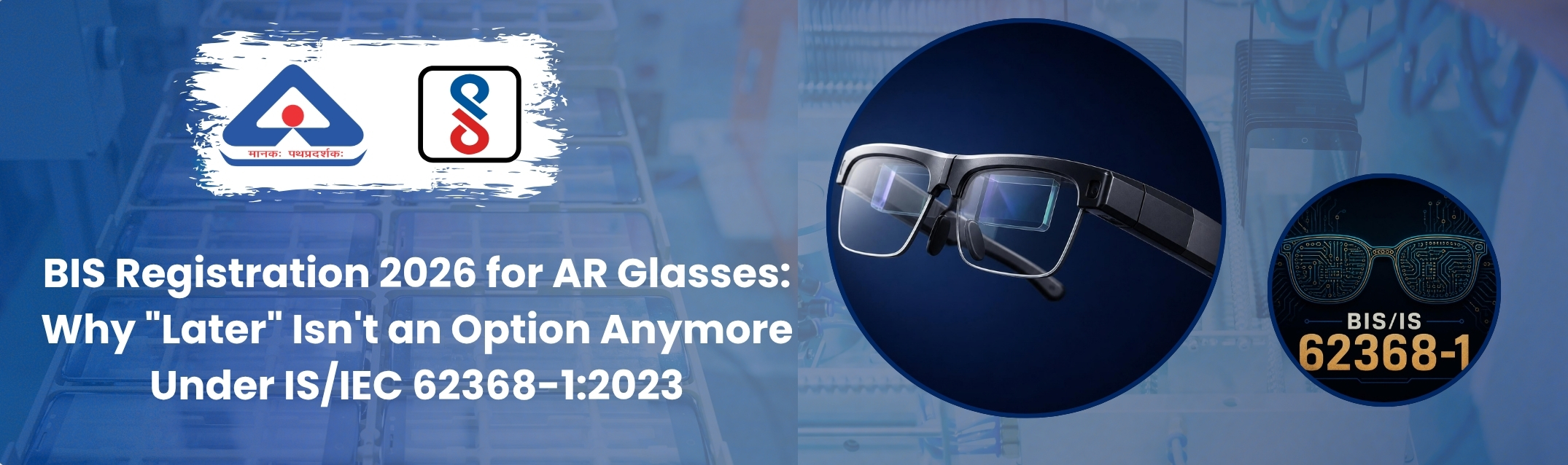
Put a display in front of the lens instead of just a camera behind it, and a pair of smart glasses stops being a camera-and-audio product in BIS's eyes and becomes something else entirely: an Extended Reality Product. AR glasses sit right at the front of that category, and unlike the audio and camera glasses we've covered elsewhere in this series, there's no older standard to fall back on here – it's IS/IEC 62368-1:2023 from day one.
This is also the point in BIS's 2026 wearable-glasses classification where the compliance clock has already run out rather than being something to prepare for. If you're building, importing, or selling AR glasses in India, this piece covers what qualifies, what the standard demands, and why "later" isn't really an option here anymore.
What Makes a Product "AR Glasses" for BIS
BIS's wearable-glasses classification circular defines AR Glasses fairly precisely: they carry the same feature set as Smart Glasses – audio, camera, or both, with or without those features – plus one thing that changes everything: an overlay display visible through the lenses. That overlay is what separates an AR product from a camera-equipped pair of smart glasses that simply looks similar from across the room.
The same circular sets out neighbouring categories worth knowing about even if they're not what this article covers: MR Glasses for devices built around interacting with digital content layered into the physical environment, VR Headsets for fully immersive devices with no see-through element, and catch-all entries like Other AR Devices for AR technology that doesn't fit the Glasses definition specifically. We've written a separate piece on BIS registration for VR Headsets covering that immersive side of the category.
If your product has audio and a camera but no overlay display, it almost certainly belongs in our earlier pieces on Smart Glasses (Video Camera) or Smart Glasses (Digital Camera) instead. The full classification map across all these categories is in our breakdown of the wearable-glasses circular and the more detailed companion guide to the 2026 AR/MR classification.
Why AR Glasses Skip Straight to IS/IEC 62368-1:2023
Audio glasses and camera-equipped smart glasses both got the option of registering under an older, product-specific safety standard while a transition period runs its course. AR glasses didn't get that option. BIS classified Extended Reality Products directly under IS/IEC 62368-1:2023, the newer hazard-based safety standard for audio, video, and IT equipment, without a parallel older-standard route.
That makes sense once you consider what's actually inside an AR device: a display engine, waveguide or projection optics, onboard processing, a battery, and often a camera, all packed into a wearable frame. That's a meaningfully more complex electronics stack than a pair of audio glasses, and it's squarely the kind of product IS/IEC 62368-1:2023 was written to evaluate holistically rather than through an older standard built around simpler audio-video devices.
What the Standard Actually Tests
IS/IEC 62368-1:2023 takes a hazard-based approach rather than a simple checklist – it looks at the energy sources inside a device and whether they're adequately contained, rather than testing against a fixed template built for one product type.
| Hazard Class | What's Assessed |
|---|---|
| Electrical Energy | Shock protection, insulation, and safe limits on accessible current and voltage |
| Thermal Energy | Surface and internal temperature limits, relevant for a device worn against the face for extended periods |
| Mechanical Energy | Build strength, sharp edges, and stress on the frame and optics assembly |
| Radiation and EMC | Emission limits from displays, sensors, and wireless components, plus electromagnetic compatibility |
| Battery and Fire Safety | Safe charging behaviour and protection against battery-related fire or fault conditions |
What this doesn't touch is equally worth knowing: display quality, field of view, tracking accuracy, or how comfortable the thing is to wear for an hour. That's product design, not BIS's remit.
This Is Already in Force – Not a Future Deadline
Here's the detail that separates this article from the rest of this series: the compliance dates for AR, VR, and MR devices have already passed. Reporting on the mandate cites an effective date of 5 December 2025, with a related note that the older audio-video and IT-equipment standards it replaces – IS 13252 (Part 1):2010 and IS 616:2017 – stopped being usable for this category around 1 May 2026.
We're flagging both dates honestly because public sources don't fully agree on which one marks the exact cut-off, and the regulatory pace on this category has moved quickly through 2026. What's not in doubt is the direction of travel: by the time you're reading this, AR glasses without valid CRS registration against IS/IEC 62368-1:2023 are not something that should still be entering the Indian market. If you're building a compliance timeline around this category, verify the current status directly with BIS or a lab before assuming either date as gospel, and treat this as urgent rather than something with runway to spare. Our IS 62368 certification guide covers the wider migration this standard is driving across BIS's electronics categories.
Who Needs to Register
-
Manufacturers building AR glasses in India
-
Importers bringing finished AR devices in from overseas, which covers the bulk of what's currently sold in India
-
Foreign manufacturers selling into India directly or through distributors, who need an Authorised Indian Representative to hold the registration
-
Brand owners and private-label sellers whose AR product is built by a third-party manufacturer
Our general guide to BIS CRS certification is a good starting point if your team hasn't handled a CRS application before.
AR Glasses Already on the Market
This category isn't theoretical. Xreal has built a real following in India for its lightweight AR glasses lineup, sold as a display accessory as much as a standalone gadget. Rokid's 2026 AI and AR glasses combine a waveguide overlay display with the camera and audio features we covered in our smart-glasses pieces. INMO's Air 3 markets itself explicitly as AR smart glasses rather than plain camera glasses. RayNeo's X3 Pro pairs its camera hardware with a genuine spatial AR display, putting it in this category rather than the plain video-camera one.
If your product includes any of these – a waveguide, birdbath, or projection display that overlays information onto what the wearer sees – you're building an AR Glasses product for BIS purposes, whatever the marketing copy calls it.
What to Do Before You Apply
-
Confirm your product has a genuine overlay display, not just a camera or audio feature set
-
Treat this as urgent – there is no older-standard grace period left to lean on
-
Pull together full design documentation covering the display, optics, battery, and wireless components
-
Book testing at a BIS-recognised laboratory that covers IS/IEC 62368-1:2023
-
Appoint an Authorised Indian Representative if you manufacture outside India
-
File under the specific "AR Glasses" product name rather than a general electronics or wearables listing
-
Don't assume a smart-glasses or camera licence extends to an AR product – each named product needs its own registration
About Absolute Veritas
Absolute Veritas is a leading Testing, Inspection, and Certification (TIC) consultancy with over 15 years of expertise, headquartered in New Delhi, India. We help manufacturers and importers of AR and XR wearables confirm the right BIS classification and carry a BIS CRS registration against IS/IEC 62368-1:2023 through testing, documentation, and approval.
Contact us today at cs@absoluteveritas.com or call +91-7303215033 for guidance on registering AR glasses or other Extended Reality Products under BIS CRS.
Frequently Asked Questions (FAQ)
Do AR glasses need BIS registration in India?
Yes. BIS classifies AR Glasses as a named product under Extended Reality Products, and registration against IS/IEC 62368-1:2023 is already mandatory rather than a future requirement.
Which standard applies to AR glasses?
IS/IEC 62368-1:2023, with no older-standard transition option, unlike audio glasses and camera-equipped smart glasses.
What makes a product "AR Glasses" rather than plain smart glasses?
An overlay display visible through the lenses. A device with only audio and a camera, no matter how advanced, falls under the Smart Glasses categories instead.
When did this requirement take effect?
Public reporting cites dates around late 2025 to mid-2026, with sources not fully aligned on the precise cut-off. Either way, the requirement is already in force, not upcoming, so it should be treated as immediate.
Are there real AR glasses products in this category already?
Yes. Brands such as Xreal, Rokid, INMO, and RayNeo all sell products with genuine overlay displays that would fall under this classification.
Does an existing smart-glasses BIS licence cover an AR product?
No. BIS requires a separate licence for each named product, so a Smart Glasses registration does not extend to AR Glasses even if the underlying hardware is similar.
Share this Post
 LinkedIn
 WhatsApp
 Facebook
CONTACT US






 ❮
❮