Tel: 0129-4001010 Phone: +91 730 321 5033
Email: cs@absoluteveritas.com

Design and Construction for Ground Improvement – Preconsolidation Using Vertical Drains IS 15284 (Part 2) : 2026
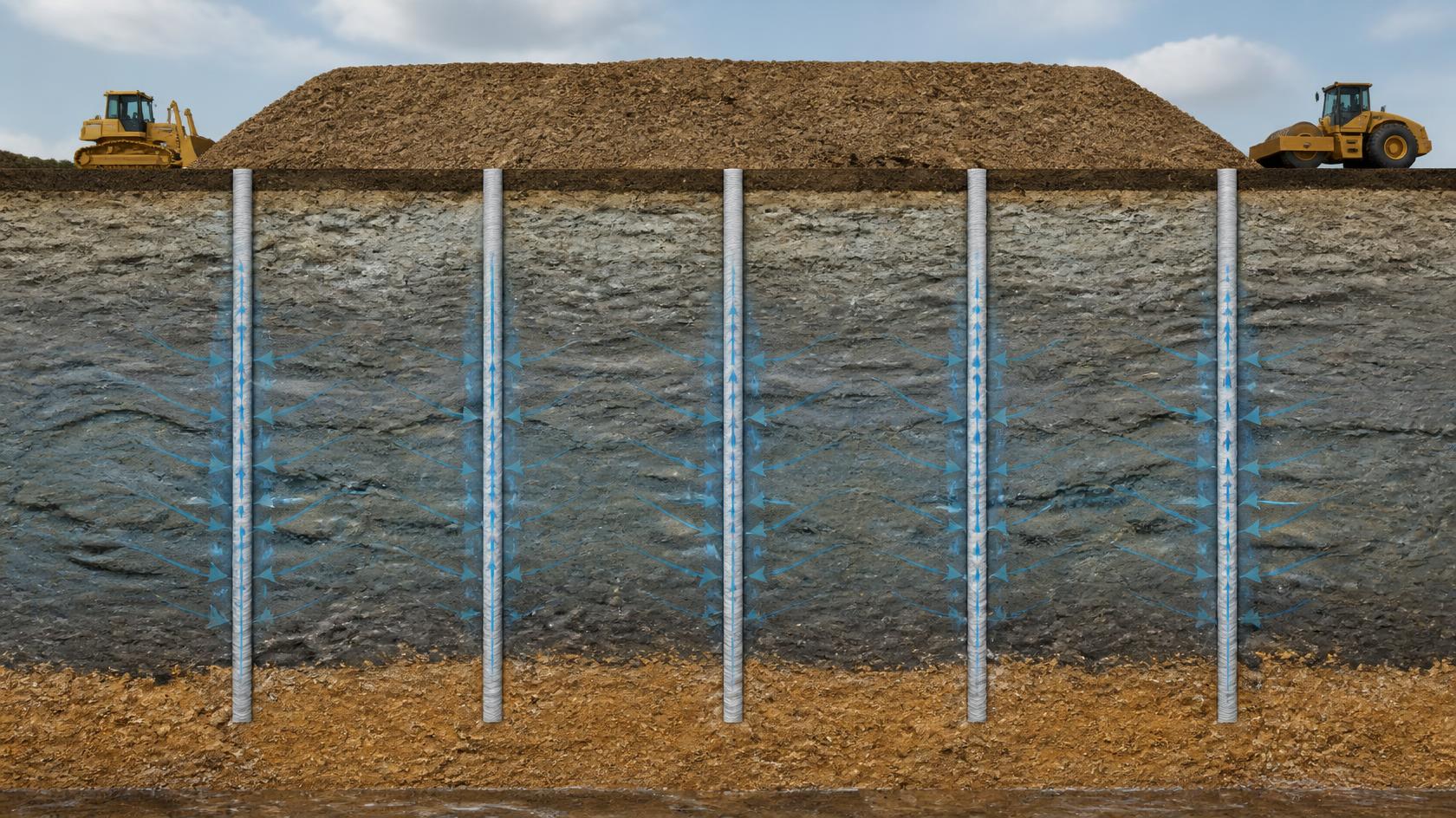
Indian Standards also provide technical codes of practice for civil and geotechnical engineering works, helping engineers and contractors apply consistent design and construction principles across infrastructure projects.
IS 15284 (Part 2) : 2026 is the Bureau of Indian Standards' Code of Practice for the design and construction of ground improvement by preconsolidation using vertical drains. BIS established this First Revision on 21 July 2026, replacing IS 15284 (Part 2) : 2004, which remains concurrently valid until 21 January 2027.
IS 15284 (Part 2) provides an engineering reference for ground-improvement works involving preconsolidation using vertical drains. This technique is commonly considered where soft, compressible or saturated soils require accelerated consolidation before construction of embankments, foundations or other civil infrastructure.
KEY DETAILS
| Standard Title | Design and Construction for Ground Improvement — Code of Practice Part 2 Preconsolidation Using Vertical Drains |
| Applicable Indian Standard | IS 15284 (Part 2) : 2026 (First Revision) |
| Standard Type | Code of Practice (ground improvement and geotechnical engineering reference) |
| Applicability | Reference standard for geotechnical engineers, designers and contractors involved in preconsolidation using vertical drains — not a directly ISI Mark-certifiable product specification |
| Superseded Standard | IS 15284 (Part 2) : 2004 (valid until 21 January 2027) |
What is IS 15284 (Part 2) : 2026?
IS 15284 (Part 2) : 2026 is the Indian Standard Code of Practice covering design and construction of ground improvement through preconsolidation using vertical drains.
Vertical drains are used as part of ground-improvement systems to shorten the drainage path within soft or saturated soils. This allows excess pore water to dissipate more efficiently during preloading or surcharge, helping the ground consolidate before the permanent structure or infrastructure is constructed.
What is Preconsolidation Using Vertical Drains?
Preconsolidation is a ground-improvement technique in which compressible soil is subjected to loading before the final structure is completed. The objective is to induce a significant portion of the expected settlement in advance.
Vertical drains can be installed within the soil to provide shorter drainage paths and accelerate consolidation. Depending on the project and soil conditions, the system may be used together with surcharge loading or other preloading methods.
Purpose of Vertical Drain Ground Improvement
Soft and compressible ground may experience significant long-term settlement when subjected to structural or embankment loads. Where natural consolidation would take a long period, engineered vertical drainage can be considered to accelerate the consolidation process.
The technique is relevant to infrastructure projects constructed over weak ground, including embankments, transport infrastructure, industrial developments and other civil engineering works where settlement control and ground preparation are important design considerations.
Revision of IS 15284 (Part 2)
IS 15284 (Part 2) : 2026 is the First Revision of IS 15284 (Part 2) : 2004. The previous edition was titled Design and Construction for Ground Improvement — Guidelines Part 2 Preconsolidation Using Vertical Drains.
BIS established the revised standard on 21 July 2026. The previous 2004 edition will continue to remain in force concurrently until 21 January 2027, after which it is scheduled to be withdrawn.
Who Uses IS 15284 (Part 2)
This standard is a working reference for:
-
Geotechnical engineers: To evaluate and design ground-improvement systems involving preconsolidation and vertical drains.
-
Civil engineering consultants: To specify suitable ground-treatment methods for infrastructure projects constructed over compressible soils.
-
Ground-improvement contractors: To execute vertical drain installation and associated ground-treatment activities in accordance with project specifications.
-
Infrastructure developers: To apply standardized engineering references when planning development over soft or compressible ground.
-
Project and quality teams: To review ground-improvement design, installation and project documentation against applicable engineering requirements.
Transition to IS 15284 (Part 2) : 2026
Organizations currently referring to IS 15284 (Part 2) : 2004 should review the revised 2026 Code of Practice and update relevant engineering specifications, design documentation, tender requirements and construction procedures during the transition period.
The earlier IS 15284 (Part 2) : 2004 remains concurrently valid until 21 January 2027.
WHY USE ABSOLUTE VERITAS?
Absolute Veritas is a prominent organisation from the private sector of India primarily dealing with the Inspection, Testing, Audits, Certification of products & consulting services to various industries in India and worldwide, ensuring compliance with regulatory standards and industry requirements. Offering a comprehensive range of services including product certification, testing, training, auditing, and compliance services, Absolute Veritas helps manufacturers, consultants and organizations stay aligned with current Indian Standards.
For any questions regarding Indian Standards for ground improvement and geotechnical engineering applications, please reach out to us via email at cs@absoluteveritas.com
Frequently asked questions (FAQ)
What does IS 15284 (Part 2) : 2026 cover?
IS 15284 (Part 2) : 2026 provides the Code of Practice for design and construction of ground improvement through preconsolidation using vertical drains.
What are vertical drains used for in ground improvement?
Vertical drains are used to provide shorter drainage paths within soft or saturated soils, helping excess pore water dissipate more efficiently and accelerating consolidation during preloading or surcharge.
Which BIS standard covers preconsolidation using vertical drains?
IS 15284 (Part 2) : 2026 is the applicable Indian Standard Code of Practice for ground improvement through preconsolidation using vertical drains.
Does IS 15284 (Part 2) require BIS certification or an ISI Mark?
No. IS 15284 (Part 2) : 2026 is a Code of Practice for engineering design and construction and is not a directly ISI Mark-certifiable product specification.
Which previous standard does IS 15284 (Part 2) : 2026 replace?
The 2026 edition replaces IS 15284 (Part 2) : 2004, Design and Construction for Ground Improvement — Guidelines Part 2 Preconsolidation Using Vertical Drains.
When will IS 15284 (Part 2) : 2004 be withdrawn?
The previous IS 15284 (Part 2) : 2004 remains concurrently in force until 21 January 2027, after which it is scheduled to be withdrawn.
Who should refer to IS 15284 (Part 2) : 2026?
The standard is relevant to geotechnical engineers, civil engineering consultants, ground-improvement contractors, infrastructure developers and project teams involved in preconsolidation and vertical-drain ground-improvement works.
BIS BLOGS
.png)
Guide to BIS CRS Registration for Products in India
The Bureau of Indian Standards (BIS) and its Compulsory Registration Scheme (CRS) play a vital role in ensuring the quality...
Read More.png)
BIS Registration Renewal: A Complete Guide
The BIS CRS (Bureau of Indian Standards/Compulsory Registration Scheme) outlines mandatory requirements for both domestic...
Read More
BIS CRS Labelling Guidelines
Under the BIS-CRS Labelling Scheme, which currently covers 78 mandatory product categories, all products must receive...
Read More%20Compliance%20Needed%20for%20Analog%20CCTV%20Cameras.png)
No Essential Requirement Compliance Needed for Analog CCTV Cameras
As per recent notification dated 12th March 2025, the Ministry of Electronics and Information Technology (MeitY) has...
Read More
Updated BIS Implementation Guidelines for IS 61683 Standard
The Bureau of Indian Standards (BIS) has released revised implementation guidelines for IS 61683, the Indian Standard...
Read More
BIS Implements IS 16270 for Solar PV Batteries
The Bureau of Indian Standards (BIS) has released updated implementation guidelines for IS 16270:2023, a crucial standard...
Read More
Share this Post
 LinkedIn
  WhatsApp
  Facebook
 CONTACT US





 ❮
❮