Tel: 0129-4001010 Phone: +91 730 321 5033
Email: cs@absoluteveritas.com

FSSAI Revised Turnover Threshold 2026: New Limits for Registration, State License & Central License
Published Date: 04 August 2026
Table of Contents
- 1. Overview
- 2. What the New Order Changes
- 3. Why FSSAI Revised These Thresholds
- 4. Old vs New Turnover Thresholds
- 5. Eligibility: Which Category Applies to You
- 6. Documents Required for Each Category
- 7. Application Process on the FoSCoS Portal
- 8. Perpetual Validity and Risk-Based Inspections
- 9. Penalties for Non-Compliance
- 10. What Businesses Should Do Now
- 11. Common Mistakes to Avoid
- 12. How Absolute Veritas Supports Food Businesses
- 13. Frequently Asked Questions
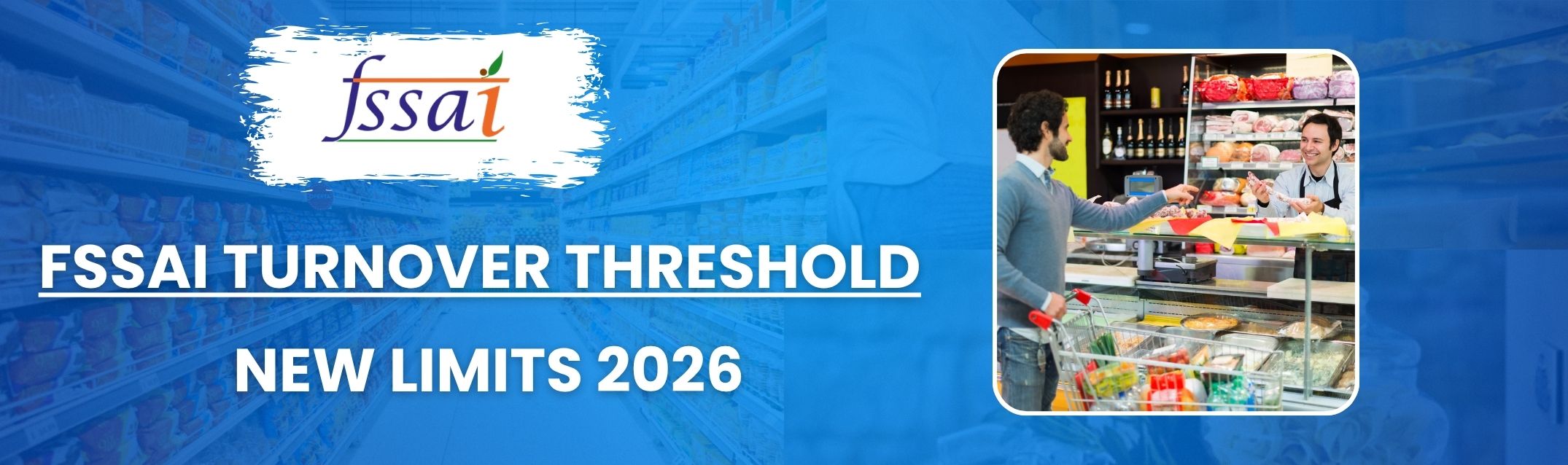
If you run a food business in India whether that's a home kitchen, a mid-size processing unit, or a national brand a new order from the Food Safety and Standards Authority of India changes the annual turnover limits that decide whether you need Basic Registration, a State License, or a Central License. The revised thresholds took effect from 1st April 2026, under an order dated 13th March 2026, and they replace classification criteria that had barely moved since 2011.
This isn't a minor administrative tweak. For a large number of food businesses, it means a lower compliance burden, simpler paperwork, and in many cases, a category downgrade they can apply for straightaway. If your turnover sits anywhere near the old thresholds, it's worth checking where you now stand.
At Absolute Veritas, we help food business operators across India get their FSSAI registration and licensing right the first time here is exactly what this revision means for you.
Overview
FSSAI functions under the Food Safety and Standards Act, 2006, and requires every Food Business Operator (FBO) manufacturers, traders, warehouses, transporters, caterers, retailers, importers, exporters, and street vendors alike to hold a valid registration or license before commencing operations. The classification between the three tiers has always been based primarily on annual turnover.
This latest order recalibrates those turnover bands under the Food Safety and Standards (Licensing and Registration of Food Businesses) Amendment Regulations, 2026. It does not remove the underlying obligation to register or license your food business it changes which tier you fall into, and in several respects, how that credential is maintained going forward.
What the New Order Changes
| Provision | Details |
|---|---|
| Turnover Thresholds Revised | The annual turnover limits for Basic Registration, State License, and Central License have all been raised significantly, effective 1st April 2026. |
| Validity Period | FSSAI registration and licenses now carry perpetual validity, replacing the earlier 1 to 5 year renewal cycles. |
| Inspection Model | Fixed periodic renewals are replaced by risk-based inspections, with frequency tied to the nature and scale of the business. |
| Legal Basis | Issued under the Food Safety and Standards Act, 2006, via the Food Safety and Standards (Licensing and Registration of Food Businesses) Amendment Regulations, 2026. |
| Effective Date | 1st April 2026, as per the official order dated 13th March 2026 (Gazette notification dated 10.03.2026). |
Why FSSAI Revised These Thresholds
The Old Thresholds Hadn't Moved Since 2011
The revision followed recommendations from NITI Aayog's High Level Committee on Non-Financial Regulatory Reforms, later approved by the Food Authority and the Ministry of Health and Family Welfare. The committee's core finding was straightforward: a turnover of ₹12 lakh was a meaningful benchmark for a small food business in 2011, but fifteen years of inflation and business growth had made that figure almost meaningless. Many small dhabas, home food entrepreneurs, and tiffin services were being pushed into State licensing requirements that were really designed for much larger operations, and street food vendors were often caught complying with two overlapping regulatory systems at once.
The amendment also gives FSSAI the flexibility to revise these thresholds by order alone going forward, rather than needing a full regulatory amendment each time so businesses should expect these numbers to be reviewed periodically rather than treated as permanent.
Old vs New Turnover Thresholds
| Category | Old Threshold | New Threshold (2026) |
|---|---|---|
| Basic Registration | Up to ₹12 Lakh | Up to ₹1.5 Crore |
| State License | ₹12 Lakh ₹20 Crore | ₹1.5 Crore ₹50 Crore |
| Central License | Above ₹20 Crore | Above ₹50 Crore |
In practical terms: a business earning ₹80 lakh a year, which previously needed a State License, now only needs Basic Registration. A company with ₹25 crore turnover, which used to require a Central License, now only needs a State License. This order supersedes all earlier FSSAI classification criteria under the Food Safety and Standards (Licensing and Registration of Food Businesses) Regulations, 2011.
Eligibility: Which Category Applies to You
FSSAI Basic Registration
Applies if your annual turnover is up to ₹1.5 crore. This covers:
- Small food retailers, street vendors, and petty food manufacturers
- Home-based food businesses, including home bakers and homemade food sellers
- Small dhabas, tea stalls, and juice shops
- Hawkers and itinerant food vendors
- Small catering businesses serving local functions or offices
- Small distributors, transporters, or storage operators under ₹1.5 crore turnover
- Temporary stall holders at events and fairs
FSSAI State License
Applies if your annual turnover is above ₹1.5 crore and up to ₹50 crore. This covers:
- Mid-size food manufacturers or processors
- Restaurant chains operating within a single state
- Food trading companies with moderate turnover
- Hotels, restaurants, and catering businesses with significant revenue
- Cold storage operators within the State License turnover range
- Food retailers operating multiple outlets within a state
- Cloud kitchen brands and meal-kit companies in growth phase
FSSAI Central License
Applies if your annual turnover is above ₹50 crore, or if your business falls into certain categories regardless of turnover:
- Large food manufacturers or processors
- Importers and exporters of food products
- Food businesses operating in more than one state
- Businesses supplying food to railways, airlines, or defence establishments
- Large e-commerce food platforms or marketplaces
Note: Even below ₹50 crore, importers, exporters, and certain multi-state operators may still require a Central License based on the nature of their operations rather than turnover alone. It's worth verifying your specific situation with a compliance consultant.
Official Source
This article is based on FSSAI's order dated 13th March 2026 (File No. RCD-01002/1/2021-Regulatory-FSSAI-Part(1)), issued by the Regulatory Compliance Division, FDA Bhawan, New Delhi. For the latest notifications, check FSSAI's official portal at fssai.gov.in or the FoSCoS portal at foscos.fssai.gov.in.
Documents Required for Each Category
For Basic Registration (Form A):
- Photo ID proof Aadhaar, PAN, Voter ID, or Passport of the applicant
- Address proof of the business premises electricity bill, rent agreement, or ownership document
- Passport-size photograph of the proprietor, partner, or director
- Completed Form A application
- Where applicable: partnership deed, certificate of incorporation, local body NOC, or turnover proof
For State License (Form B):
- Photo ID and address proof of proprietor, partners, or directors
- Business address proof and constitution documents (partnership deed / incorporation certificate / MOA & AOA)
- Completed Form B, list of food products, and layout plan of the premises
- Food Safety Management System (FSMS) plan, municipal NOC, and water testing report
- Self-declaration form, plus business-type-specific documents (machinery list for manufacturers, sourcing proof for dairy units, temperature records for cold storage)
For Central License (Form B, expanded):
- All documents required for a State License
- Import Export Code (IEC) from DGFT, for importers and exporters
- NOC from the Pollution Control Board, for large manufacturing units
- CA-certified statement of annual turnover above ₹50 crore
- Food Safety Management System certification such as ISO 22000 or FSSC 22000, where applicable
- Third-party audit report and a full list of all premises or branches
Application Process on the FoSCoS Portal
- Determine your category based on current annual turnover, using the revised thresholds
- Create an account on foscos.fssai.gov.in using your mobile number or email, and verify via OTP
- Select the correct form Form A for Basic Registration, Form B for State or Central License
- Fill in business, product, and turnover details accurately
- Upload the required documents (PDF, JPG, or PNG, generally under 1–2 MB each)
- Pay the applicable fee online through the portal
- Submit the application and track its status using the reference number provided
- Undergo inspection where applicable mandatory pre-grant for State and Central License, risk-based post-registration for Basic Registration
- Download the issued certificate, display it at your premises, and add your 14-digit FSSAI number to labels and packaging
| Category | Approximate Fee |
|---|---|
| Basic Registration | ₹100 per year (now a one-time perpetual fee verify current rate on the portal) |
| State License | ₹2,000 ₹5,000, depending on the nature and scale of the business |
| Central License | ₹7,500 per year of license check the portal for the latest fee schedule |
If you already hold a registration or license and your turnover has shifted categories, there's no automatic cancellation. You can apply to modify, upgrade, or downgrade your credential through FoSCoS to reflect your current turnover.
Perpetual Validity and Risk-Based Inspections
Registrations and Licenses No Longer Expire
Previously, FSSAI credentials were issued for fixed periods of 1 to 5 years, and missing a renewal deadline meant technically operating without valid authorisation. Under the 2026 amendment, once a registration or license is granted, it does not expire, provided the business stays compliant with food safety norms and hasn't been suspended or had its credential cancelled. In place of fixed renewals, FSSAI relies on risk-based inspections, timed according to the nature of the business rather than a calendar cycle.
Risk level is assessed against a few consistent factors:
- Nature of the food product ready-to-eat versus raw, processed versus unprocessed, perishable versus shelf-stable
- Vulnerability of consumers products for infants, the elderly, or hospital patients carry higher scrutiny
- Scale of operation larger businesses with wider reach attract more frequent checks
- Compliance history prior violations lead to closer monitoring
- Type of operation manufacturing and processing are treated as higher risk than retail or storage
Penalties for Non-Compliance
The revised thresholds make compliance easier to achieve, but the penalty framework under the Food Safety and Standards Act, 2006 hasn't changed, and it applies equally regardless of which tier you hold.
| Violation | Penalty |
|---|---|
| Operating without registration or license | Up to ₹5 lakh |
| Selling food not meeting FSSAI standards | Up to ₹5 lakh |
| Manufacturing or selling substandard food | Up to ₹5 lakh |
| Selling adulterated food (not injurious to health) | Up to ₹3 lakh |
| Selling adulterated food (injurious to health) | Up to ₹10 lakh |
| False labelling or misleading advertisements | Up to ₹10 lakh |
| Selling unsafe food causing grievous hurt | Imprisonment up to 7 years + ₹10 lakh fine |
| Selling unsafe food causing death | Imprisonment for life + ₹10 lakh fine |
What Businesses Should Do Now
- Recalculate which category Basic Registration, State License, or Central License applies to your current annual turnover
- If you already hold a credential and your category has changed, apply for modification on FoSCoS rather than leaving it as is
- Check whether special triggers apply to you regardless of turnover, such as import/export activity or multi-state operations
- Gather the correct document set for your applicable tier well before you plan to apply
- Understand that perpetual validity does not reduce your food safety obligations risk-based inspections still apply
Common Mistakes to Avoid
- Assuming your old license category is still correct without checking it against the revised thresholds
- Treating perpetual validity as freedom from inspection altogether risk-based checks still apply
- Ignoring the special Central License triggers for importers, exporters, and multi-state operators, even below ₹50 crore turnover
- Delaying registration entirely because the process seems complex Basic Registration in particular is designed to be simple
- Forgetting to update your FSSAI number on labels and packaging after a category change
How Absolute Veritas Supports Food Businesses
Absolute Veritas helps food business operators across India navigate FSSAI registration and licensing under the revised 2026 thresholds, including:
- FSSAI Registration in India for small retailers, home-based food businesses, and street vendors applying for Basic Registration
- FSSAI State License for mid-size manufacturers, restaurants, and multi-outlet retailers
- FSSAI Certification covering Central License and broader food safety certification needs for large manufacturers, importers, exporters, and multi-state operators
- Category modification, upgrade, or downgrade filings through FoSCoS for existing license holders
- Documentation review, application filing, and coordination through to certificate issuance
- Ongoing compliance guidance as FSSAI risk-based inspection norms are rolled out
Need help figuring out which FSSAI category applies to your business, or updating your existing registration?
Connect with Absolute Veritas at cs@absoluteveritas.com for professional guidance on FSSAI registration, licensing, and regulatory coordination across India.
Frequently Asked Questions (FAQ)
What is the new FSSAI registration turnover limit from April 2026?
Basic Registration now applies to annual turnover up to ₹1.5 crore, up from the earlier ₹12 lakh limit.
What is the new FSSAI State License turnover range?
State License now applies to businesses with annual turnover above ₹1.5 crore and up to ₹50 crore.
Who needs an FSSAI Central License after April 2026?
Businesses with annual turnover above ₹50 crore, along with importers, exporters, and certain multi-state operators regardless of turnover.
Do I need to renew my FSSAI registration or license every year now?
No. Under the 2026 amendment, FSSAI registration and licenses carry perpetual validity and do not expire, provided the business remains compliant.
My current turnover is ₹80 lakh. Do I need a State License or registration?
Since ₹80 lakh falls within the ₹1.5 crore threshold, only Basic Registration is required.
I hold a State License with ₹40 lakh turnover. Can I downgrade to registration?
Yes. Since your turnover is below the new ₹1.5 crore threshold, you can apply for a category modification on the FoSCoS portal to convert to Basic Registration.
What is FoSCoS?
FoSCoS (Food Safety Compliance System) is FSSAI's official digital platform for all registration and licensing applications, available at foscos.fssai.gov.in.
What documents do I need for Basic FSSAI Registration in 2026?
A photo ID (Aadhaar or PAN), address proof of your business premises, a passport-size photograph, and a completed Form A. The documentation requirement is deliberately kept minimal for this tier.
Does this order apply to online food businesses and cloud kitchens?
Yes. All food businesses operating in India, whether physical or online, including cloud kitchens and home food sellers, must comply with FSSAI's categorisation norms.
I sell homemade food on Instagram. Do I need FSSAI registration?
Yes. Selling food products, even through social media, makes you a Food Business Operator, requiring at minimum a Basic FSSAI Registration.
What is risk-based inspection and how often will my business be inspected?
Risk-based inspection means FSSAI inspects your premises according to your business's assessed risk level rather than a fixed calendar. Low-risk businesses, such as a small grocery store, are inspected less often; high-risk businesses, such as dairies or large manufacturers, face more frequent checks.
Can FSSAI revise these thresholds again in the future?
Yes. The 2026 amendment allows the Food Authority to revise turnover thresholds by order alone, without needing a full regulatory amendment, so the current limits could change again.
Note: This content is for guidance only. In case of any inconsistency, the Food Safety and Standards Act, 2006, the Food Safety and Standards (Licensing and Registration of Food Businesses) Regulations, 2011, the Amendment Regulations, 2026, and FSSAI's order dated 13th March 2026 shall prevail.
Share this Post
 LinkedIn
  WhatsApp
  Facebook
 CONTACT US




 ❮
❮