Tel: 0129-4001010 Phone: +91 730 321 5033
Email: cs@absoluteveritas.com

BIS Update 2026: Mandatory Certification for Smartphone Screen Protectors Under IS 19348:2025
Table of Content
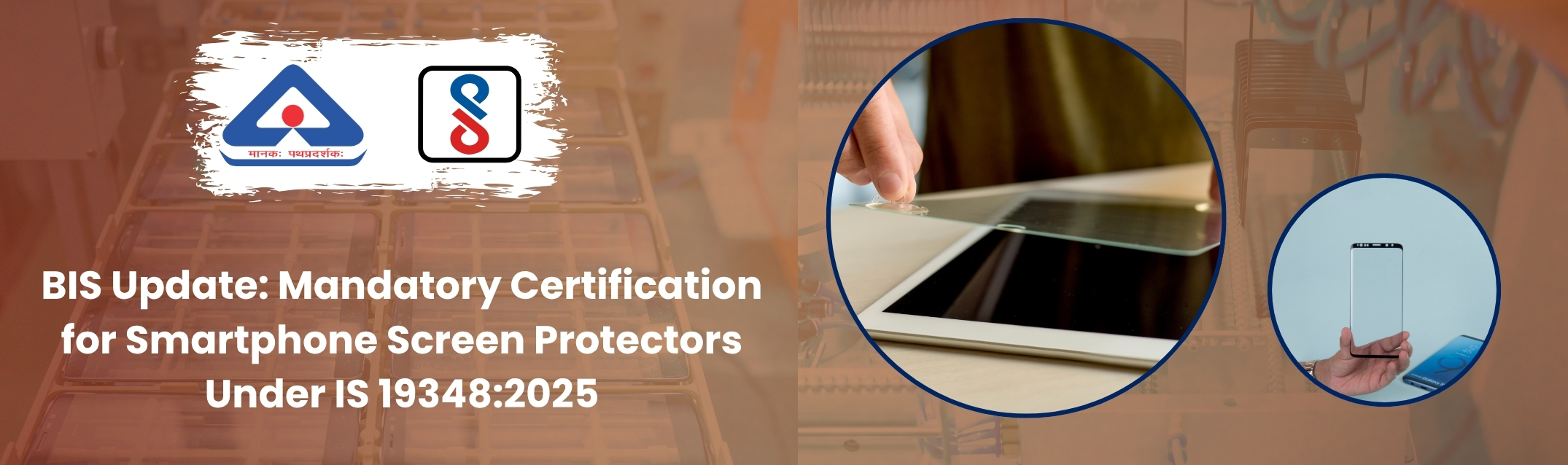
The Ministry of Electronics and Information Technology (MeitY) has brought smartphone screen protectors under mandatory BIS certification through the Compulsory Registration Scheme (CRS), requiring conformity to IS 19348:2025 – Glass Screen Protector – Specification.
The notification was issued on 21 September 2026, and the requirement becomes mandatory with effect from 1 April 2027. From that date, a screen protector that hasn't been tested and registered with BIS cannot legally be manufactured, imported, stored for sale, sold, or distributed anywhere in India.
What the Notification Covers
The update amends an existing compulsory registration framework rather than creating a new one. Here's the core detail at a glance:
| Particular | Details |
| Notification | S.O. 5190(E), dated 21 September 2026 |
| Issued By | Ministry of Electronics and Information Technology (MeitY) |
| Order Amended | Electronics and Information Technology Goods (Requirement of Compulsory Registration) Order, 2021 |
| New Schedule Entry | S. No. 66 – Screen Protectors for Smartphones |
| Applicable Indian Standard | IS 19348:2025 – Glass Screen Protector – Specification |
| Certification Route | BIS Scheme-II (Compulsory Registration Scheme) |
| Effective Date | 1 April 2027 |
Screen protectors join an already long list of notified products under this Order – smartphones, laptops, mobile and laptop chargers, LED televisions, microwave ovens, printers, and set-top boxes are among the 65 categories that came before this one.
What Is IS 19348:2025?
IS 19348:2025 is the Indian Standard BIS published for glass screen protectors, finalised in July 2025. It is the technical benchmark every covered product will now be tested against before it can carry the BIS mark.
Based on available reporting, the standard sets requirements across:
| Parameter | What Is Checked |
|---|---|
| Glass Quality | Thickness, dimensions, and mechanical strength |
| Optical Clarity | Light transmission and visible defects such as pinholes, air pockets, and uneven adhesive |
| Adhesive Performance | Bonding quality and consistency of the adhesive layer |
| Added Features | Anti-shatter films, oleophobic coatings, anti-glare treatment, blue-light filtering, privacy films (where applicable) |
Two figures reported widely in coverage of the standard: a minimum light transmission of roughly 89% for standard clear glass and around 59% for privacy-tint variants, along with a fragmentation requirement so a broken protector crumbles into dull, blunt pieces rather than sharp shards. Treat these as press-reported figures – confirm exact values and test methods against the standard document itself before finalising a product specification.
Why Has the Government Stepped In?
The India Cellular & Electronics Association (ICEA), which contributed market data and technical input while this standard was developed, has pointed to a market where products marketed as "tempered glass" often were never properly tempered at all, with retail prices ranging anywhere from roughly ₹50 to ₹2,500 bearing little relation to actual quality.
ICEA estimates India consumes around 500 million screen protectors annually, with more than 90% currently imported. A separate estimate reported by Business Standard puts the tempered-glass segment specifically at about 400 million pieces and roughly ₹20,000 crore in retail value for 2025 – the figures differ because they measure the market slightly differently, but both point to a very large, largely unregulated category.
There is a revenue dimension too: industry voices have flagged under-invoicing and informal import channels as a source of tax leakage, and ICEA has projected that formalising the category could support a ₹12,000–16,000 crore domestic manufacturing base and around 60,000 direct and indirect jobs. These are industry projections rather than government commitments, so they're best read as an optimistic scenario rather than a guarantee.
Who Is Affected by This Update
-
Indian manufacturers of glass screen protectors
-
Importers bringing product in, largely from Chinese factories at present
-
Foreign manufacturers exporting to India directly, through distributors, or via marketplaces
-
Brand owners and private-label sellers whose products are manufactured by a third party
-
Distributors, retailers, and e-commerce sellers, since storing or selling non-registered stock after the deadline is also restricted
To be clear on scope: this is not a ban on screen protectors. It is a requirement that covered products meet the standard and carry valid BIS registration. Products that clear testing and registration continue to be sold exactly as before, carrying the BIS Standard Mark.
Is Your Product Actually in Scope?
This is worth resolving before any testing spend. The schedule entry is worded broadly as "screen protectors for smartphones," but the standard it is mapped to, IS 19348:2025, is titled specifically for glass screen protectors.
If your product range includes film, hydrogel, PET/TPU, or hybrid protectors, it is not yet clear from public information how these will be treated. Review the notification text and the standard carefully, and where ambiguity remains, seek written clarification from BIS or MeitY rather than assuming coverage or exemption either way.
What Manufacturers and Importers Should Do Now
-
Confirm whether your specific products fall under S. No. 66 and IS 19348:2025
-
Obtain the standard and run a gap assessment against your current product range
-
Appoint an Authorised Indian Representative (AIR) if you manufacture outside India
-
Book testing slots with a BIS-recognised laboratory early, ahead of pre-deadline demand
-
File your BIS CRS application with test reports and supporting factory documentation
-
Update packaging to carry the BIS Standard Mark and registration (R) number
-
Brief importers, distributors, and marketplace partners on the upcoming requirement
-
Plan for clearing non-compliant stock ahead of the deadline, pending further BIS guidance
-
Once registered, track renewals and model changes – surveillance continues after approval
About Absolute Veritas
Absolute Veritas is a leading Testing, Inspection, and Certification (TIC) consultancy with over 15 years of expertise, headquartered in New Delhi, India. We help screen protector manufacturers and importers – including foreign manufacturers – manage the transition to IS 19348:2025, from scope confirmation and gap assessment, to coordinating with BIS-recognised laboratories, to managing CRS registration, Authorised Indian Representative arrangements, and documentation.
Contact us today at cs@absoluteveritas.com or call +91-7303215033 for expert guidance on your BIS CRS registration for screen protectors.
Frequently Asked Questions (FAQ)
Is BIS certification mandatory for screen protectors in India?
Yes. Smartphone screen protectors are covered under S. No. 66 of the CRO 2021, requiring conformity to IS 19348:2025, effective 1 April 2027.
Which standard applies to screen protectors?
IS 19348:2025 – Glass Screen Protector – Specification, published by BIS in July 2025.
Which BIS scheme covers this certification?
The Compulsory Registration Scheme (CRS), also referred to as BIS Scheme-II. See our full guide to BIS CRS registration for the step-by-step process.
When does the requirement come into force?
The requirement becomes mandatory from 1 April 2027. The notification itself was issued on 21 September 2026, giving businesses a preparation window.
Does the requirement apply to imported screen protectors?
Yes. Importers must ensure products are BIS-registered, and manufacturers based outside India need to appoint an Authorised Indian Representative to register.
Does this cover film or hydrogel screen protectors?
The mapped standard, IS 19348:2025, is written specifically for glass screen protectors. Coverage for film, hydrogel, or hybrid products is not clearly established in public information, so businesses in this category should seek direct clarification from BIS or MeitY.
Will screen protector prices increase because of this rule?
The Gazette notification does not address pricing. Testing and registration do add cost for manufacturers, and how much of that reaches consumers will depend on the market.
Share this Post
 LinkedIn
 WhatsApp
 Facebook
CONTACT US

 ❮
❮