Tel: 0129-4001010 Phone: +91 730 321 5033
Email: cs@absoluteveritas.com

BIS Certification for Shoes in India: QCO, ISI Mark, Standards & Process
Table of Content
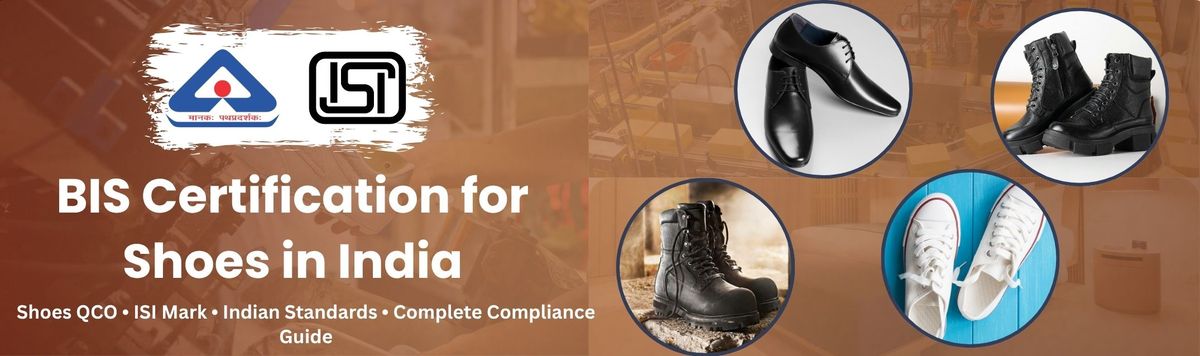
The Ministry of Commerce and Industry has issued the Footwear made from Leather and other Materials Quality Control Order, making BIS certification mandatory for various categories of shoes and footwear products in India. Covered products must comply with the applicable Indian Standards and bear the BIS Standard Mark before being manufactured, imported, sold, or distributed in the Indian market.
The Shoes QCO covers multiple footwear categories including shoes for services, shoes for general purpose, anti-riot shoes, canvas shoes with rubber sole, and leather safety boots and shoes for miners and heavy metal industries. Manufacturers must obtain BIS certification under Scheme-I of the BIS Conformity Assessment Regulations, 2018.
For domestic manufacturers, certification is granted under the BIS ISI Mark Certification Scheme. For foreign manufacturers exporting covered shoes to India, BIS certification is required under the Foreign Manufacturers Certification Scheme (FMCS).
Why Is BIS Certification for Shoes Important?
BIS certification ensures that shoes and footwear products meet the required quality, safety, durability, and performance standards. Footwear used for services, industrial safety, mining, heavy metal industries, and anti-riot applications must provide reliable protection and performance under intended conditions of use.
With the implementation of the Shoes Quality Control Order, covered footwear products cannot be sold in India without BIS certification and the ISI Mark. Compliance helps manufacturers avoid regulatory penalties, customs restrictions, market withdrawal, and supply-chain disruptions.
BIS Certification Compliance for Shoes
The Shoes QCO requires covered footwear products to conform to the applicable Indian Standard and bear the BIS Standard Mark under a valid BIS licence. The certification process includes product testing, documentation review, factory inspection, and approval by BIS.
Manufacturers must identify the correct Indian Standard based on the shoe type, intended use, material, sole construction, and safety application. Different shoe categories are covered under different Indian Standards, and separate BIS scope may be required depending on the product category.
Products Covered Under Shoes QCO
The following shoe and footwear categories are covered under the Shoes Quality Control Order:
|
Goods or Articles |
Indian Standard |
Title / Product Category |
|
Shoes / Footwear |
IS 17043 (Part 1):2024 |
|
|
IS 17043 (Part 2):2024 |
||
|
IS 17037:2018 |
||
|
IS 3735:1996 |
||
|
IS 1989 (Part 1):1986 |
||
|
IS 1989 (Part 2):1986 |
Leather Safety Boots and Shoes - Part 2 for Heavy Metal Industries |
Product Details
IS 17043 (Part 1):2024 — Shoes for Services and General Purpose
This standard applies to shoes intended for services and general-purpose use. These footwear products must meet the prescribed construction, material, performance, and quality requirements before being placed in the Indian market.
IS 17043 (Part 2):2024 — Shoes for General Purpose
This standard covers shoes for general-purpose use under the Footwear made from Leather and other Materials QCO. Manufacturers must obtain BIS certification and mark the product with the BIS Standard Mark after licence approval.
IS 17037:2018 — Anti-Riot Shoes
Anti-riot shoes are protective footwear designed for law enforcement, security forces, and field applications where durability, protection, and performance are critical. These products must comply with IS 17037:2018 under the Shoes QCO.
IS 3735:1996 — Canvas Shoes with Rubber Sole
Canvas shoes with rubber soles are commonly used for school, service, casual, institutional, and general-purpose applications. Under the QCO, these products must comply with IS 3735:1996 and bear the BIS Standard Mark.
IS 1989 (Part 1):1986 — Leather Safety Boots and Shoes for Miners
Leather safety boots and shoes for miners are designed to provide protection in mining environments. These products must comply with IS 1989 (Part 1):1986 and meet BIS certification requirements before sale or import in India.
IS 1989 (Part 2):1986 — Leather Safety Boots and Shoes for Heavy Metal Industries
Leather safety boots and shoes for heavy metal industries are used in demanding industrial environments where protection, strength, and durability are essential. These products must comply with IS 1989 (Part 2):1986 under the QCO.
Process to Obtain BIS Certification for Shoes
Obtaining BIS certification for shoes requires compliance with the applicable Indian Standard and completion of the BIS conformity assessment process. The process applies to Indian manufacturers as well as foreign manufacturers exporting covered shoes to India.
Steps to Obtain BIS Certification for Shoes:
-
Identify the applicable Indian Standard based on shoe category and intended use.
-
Prepare product specifications, manufacturing details, quality control documents, and required declarations.
-
File the BIS application under the applicable certification scheme.
-
Submit product samples for testing at a BIS-recognized laboratory.
-
Complete factory inspection by BIS officials.
-
Resolve BIS technical or documentation queries, if raised.
-
Obtain BIS licence and use the ISI Mark on certified shoe products.
About Absolute Veritas
Absolute Veritas is a trusted BIS certification and regulatory compliance consultancy supporting Indian and foreign manufacturers with BIS ISI Mark certification, FMCS certification, product testing coordination, documentation, factory audit support, and post-certification compliance.
Our team assists shoe and footwear manufacturers in identifying the correct Indian Standard, preparing application documents, coordinating BIS-recognized lab testing, handling BIS queries, and completing the certification process efficiently.
For any questions regarding BIS certification for shoes, please contact us at cs@absoluteveritas.com
Frequently Asked Questions (FAQ)
Is BIS certification mandatory for shoes in India?
Yes, BIS certification is mandatory for shoes and footwear products covered under the Footwear made from Leather and other Materials Quality Control Order.
Which shoe products are covered under the Shoes QCO?
The QCO covers shoes for services and general purpose, anti-riot shoes, canvas shoes with rubber sole, and leather safety boots and shoes for miners and heavy metal industries.
Is BIS FMCS certification required for imported shoes?
Yes, foreign manufacturers exporting covered shoes to India must obtain BIS certification under the Foreign Manufacturers Certification Scheme before selling or importing the products into India.
Can one BIS licence cover all types of shoes?
Not necessarily. Since different shoe categories are covered under different Indian Standards, the BIS licence scope depends on the applicable standard, product design, and BIS approval.
Who can help with BIS certification for shoes?
Absolute Veritas can support manufacturers with BIS application filing, documentation, testing coordination, audit support, FMCS assistance, and complete certification guidance for shoe products.
Share this Post
 LinkedIn
 WhatsApp
 Facebook
CONTACT US






 ❮
❮