Tel: 0129-4001010 Phone: +91 730 321 5033
Email: cs@absoluteveritas.com

BIS Registration 2026 for Smart Glasses (Digital Camera): IS 616:2017 / IEC 60065:2014
Table of Content
- 1. Introduction
- 2. How BIS Classifies Smart Glasses With a Camera
- 3. What IS 616:2017 / IEC 60065:2014 Actually Covers
- 4. The Standard Is Changing Underneath This Category Too
- 5. Who Needs to Register
- 6. Photo-Only or Photo-Plus-Video? Get This Right First
- 7. What to Do Before You Apply
- 8. About Absolute Veritas
- 9. Frequently Asked Questions (FAQ)
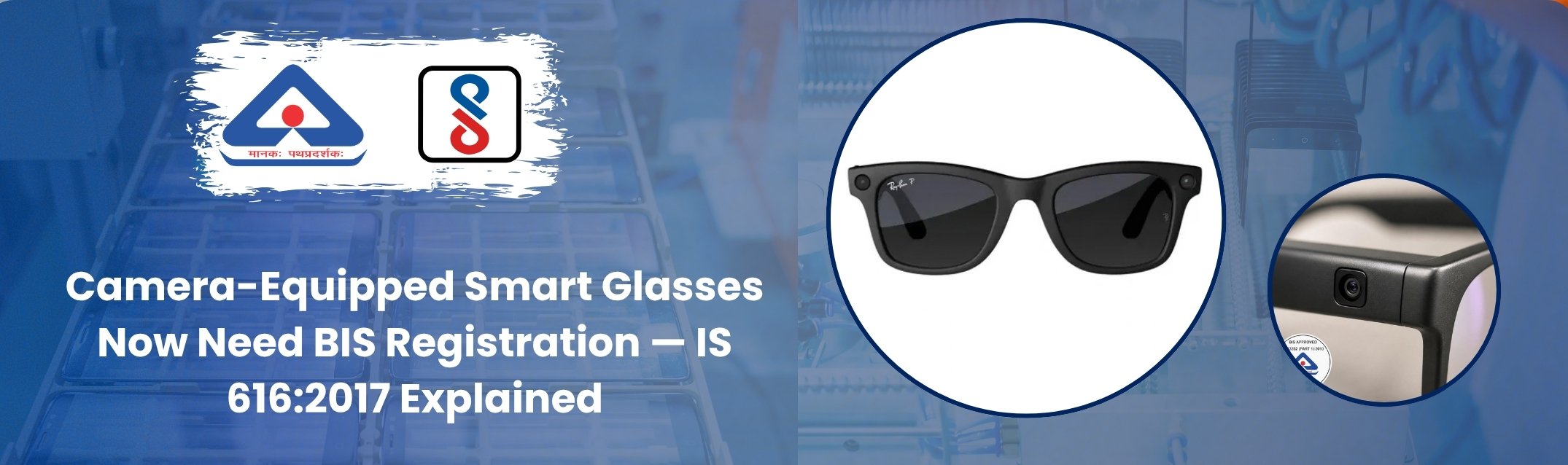
Add a camera to a pair of smart glasses and you've moved into different regulatory territory than plain audio glasses. Where audio-only glasses sit under the Wireless Earphones and Headphones category, a pair with a built-in camera gets treated by BIS as a wearable version of a Digital Camera, which currently pulls in IS 616:2017, aligned with IEC 60065:2014.
This is the second piece in our look at how BIS sorted wearable eyewear into its existing CRS product tables in 2026, and it covers the camera-carrying end of that spectrum – what the applicable standard actually tests, why it's mid-transition to something newer, and the one classification detail that decides which bucket your product falls into in the first place.
How BIS Classifies Smart Glasses With a Camera
The same 13 August 2026 circular that brought audio glasses under CRS also dealt with the camera-equipped end of the wearables spectrum, and it did it by splitting "smart glasses" into two distinct product names rather than treating them as one thing:
| Product Name | What Defines It |
|---|---|
| Smart Glasses (Digital Camera) | Audio-glasses features (with or without them), plus a camera that captures still photographs only |
| Smart Glasses (Video Camera) | The same feature set, but the camera can also record video |
That one word – video – is the whole dividing line. A device that only ever takes still pictures stays in the Digital Camera bucket covered here; the moment it can record moving footage, it shifts into the Video Camera product name instead, which we've written about separately. Neither of these is the same bucket as plain audio glasses, which we covered in our piece on BIS registration for audio glasses under IS 13252 (Part 1):2010, or AR/MR glasses, which sit under Extended Reality Products entirely. The full classification logic behind all of this is in our breakdown of the wearable-glasses classification circular and the more detailed companion guide to the 2026 smart-glasses and AR/MR classification.
What IS 616:2017 / IEC 60065:2014 Actually Covers
IS 616:2017, aligned with the international IEC 60065:2014 standard, is India's safety standard for audio, video and similar electronic apparatus. It's the same standard that's long applied to ordinary digital and video cameras, which is why a camera bolted onto a pair of glasses inherits it rather than getting a bespoke eyewear standard of its own.
| Requirement Area | What It Looks At |
|---|---|
| Electric Shock Protection | Insulation adequacy and safe limits on accessible voltage |
| Radiation Safety | Limits on any emitted radiation from the device's components |
| Fire and Thermal Hazards | Material flammability and heat build-up under normal and fault conditions |
| Mechanical Stability | Build quality, component security, and resistance to physical stress |
None of this speaks to lens quality, image resolution, or how well the camera actually performs – that's outside BIS's scope entirely. This is purely a safety clearance: can the device be worn and used without posing an electrical, thermal, or physical risk to the person wearing it.
The Standard Is Changing Underneath This Category Too
If this transition sounds familiar, it's because it's the same one running across most of BIS's electronics categories right now. Back in October 2025, MeitY notified IS/IEC 62368-1:2023 as the replacement for both IS 616:2017 and IS 13252 (Part 1):2010, with a dual-compliance window that stays open until 1 November 2028.
In practical terms, that means a Smart Glasses (Digital Camera) product can be registered against IS 616:2017 today and remain valid right through the transition, provided the licence gets migrated or renewed under the newer standard before the 2028 cut-off. Registering fresh against IS/IEC 62368-1:2023 from the outset is also allowed, and for a product with a long expected shelf life, it can save a re-certification cycle down the line. We go through that later deadline in more detail in our IS 62368 certification guide, and our page on BIS registration for digital cameras under IS/IEC 62368-1:2023 covers the newer-standard route for this same underlying product type.
Either way, this isn't a standard to treat as settled and permanent. Anyone building a compliance plan around IS 616:2017 today should already have 2028 marked on the calendar.
Who Needs to Register
-
Manufacturers building camera-equipped smart glasses in India
-
Importers bringing finished units in from overseas factories
-
Foreign manufacturers selling into India directly or via distributors, who'll need an Authorised Indian Representative to hold the registration
-
Brand owners and private-label sellers whose product is manufactured by a third party
If CRS registration is new territory for your team, our general guide to BIS CRS certification walks through documentation, testing, and the application process from the ground up.
Photo-Only or Photo-Plus-Video? Get This Right First
This is worth sitting with before you file anything, because it's the single detail that decides which product name – and which testing path – you're actually on. A device marketed as taking "photos and short clips" is a video-recording device for classification purposes, full stop; there's no partial-credit category for glasses that mostly take photos but occasionally record a few seconds of footage.
Here's the practical catch: look at what's actually selling in India right now, and almost nothing fits the photo-only definition. Rokid's 2026 AI and AR glasses ship with a 12MP camera that shoots 3K video, not just stills. INMO's Air 3 carries an ultra-wide camera built for video capture. RayNeo's X3 Pro pairs a 12MP Sony sensor with a separate spatial camera, again with video as a core feature. Meta's Ray-Ban line has followed the same pattern since its first camera-equipped model – photos and video together, not one or the other. Every one of these would fall under the Video Camera product name, not the Digital Camera category this article covers.
That's worth sitting with for a moment: a genuinely photo-only camera, with video capability switched off or physically absent, is the exception in this market rather than the norm. If your product matches what's actually shipping from brands like these, you're almost certainly looking at the Video Camera classification. The Digital Camera route covered here fits a narrower slice of the market – devices built deliberately without video recording, not ones where video was simply left out of the marketing copy.
What to Do Before You Apply
-
Confirm the camera is genuinely photo-only – any video capability changes the applicable product name
-
Decide between IS 616:2017 and IS/IEC 62368-1:2023 based on your product's expected market life
-
Pull together circuit, battery, and enclosure documentation for whichever standard you choose
-
Book testing at a BIS-recognised laboratory that covers the relevant standard
-
Appoint an Authorised Indian Representative if you manufacture outside India
-
File under the exact product name – Smart Glasses (Digital Camera) – rather than a generic camera or eyewear listing
-
Don't assume an existing digital camera or audio-glasses licence extends to this product; each named product needs its own registration
About Absolute Veritas
Absolute Veritas is a leading Testing, Inspection, and Certification (TIC) consultancy with over 15 years of expertise, headquartered in New Delhi, India. We help manufacturers and importers of camera-equipped wearables work out the right BIS classification, choose between IS 616:2017 and IS/IEC 62368-1:2023, and carry a BIS CRS registration through testing, documentation, and approval.
Contact us today at cs@absoluteveritas.com or call +91-7303215033 for guidance on registering smart glasses or other camera-equipped wearables under BIS CRS.
Frequently Asked Questions (FAQ)
Do smart glasses with a camera need BIS registration in India?
Yes. BIS's August 2026 classification circular treats camera-equipped smart glasses as a named product under the Compulsory Registration Scheme, split into photo-only "Digital Camera" and photo-plus-video "Video Camera" variants.
Which standard applies to Smart Glasses (Digital Camera)?
IS 616:2017, aligned with IEC 60065:2014, currently applies, alongside the newer IS/IEC 62368-1:2023, which is set to fully replace it once the transition period ends on 1 November 2028.
What's the difference between Smart Glasses (Digital Camera) and Smart Glasses (Video Camera)?
Whether the camera can record video. Photo-only devices fall under the Digital Camera product name; any video-recording capability moves the product into the Video Camera category instead.
What does IS 616:2017 actually test for?
Electric shock protection, radiation safety, fire and thermal hazards, and mechanical stability – general safety checks for audio, video and similar electronic apparatus, not image quality or camera performance.
Can an existing digital camera BIS licence cover smart glasses with a camera?
No. BIS requires a separate licence for each named product, so a standalone digital camera registration does not automatically extend to a camera built into wearable glasses.
Should we register under IS 616:2017 or go straight to IS/IEC 62368-1:2023?
It depends on the product's expected market life. A short-term product may find IS 616:2017 practical if testing infrastructure already exists; a longer-life product is often better registered directly under IS/IEC 62368-1:2023 to avoid re-certification before the 2028 deadline.
Share this Post
 LinkedIn
 WhatsApp
 Facebook
CONTACT US






 ❮
❮