Tel: 0129-4001010 Phone: +91 730 321 5033
Email: cs@absoluteveritas.com

BIS Revised Series Guidelines for IS/IEC 62368-1:2023 – Everything Manufacturers Need to Know
Published Date: 25 May 2026
Table of Contents
- 1. Why BIS Issued These Revised Series Guidelines
- 2. What Is a Product Family Under IS/IEC 62368-1:2023?
- 3. 8 Key Rules for BIS Series Grouping
- 4. Products That Must Always Be Registered Separately
- 5. Special Provisions and Flexibility Areas
- 6. Effective Date and Who This Applies To
- 7. Steps Businesses Should Take Before Sending Samples
- 8. BIS FAQs on Migration – Licence, Renewal & Standard Mark Rules (22 July 2026)
- 9. Key Migration Dates at a Glance
- 10. How Absolute Veritas Supports Businesses
- 11. Frequently Asked Questions
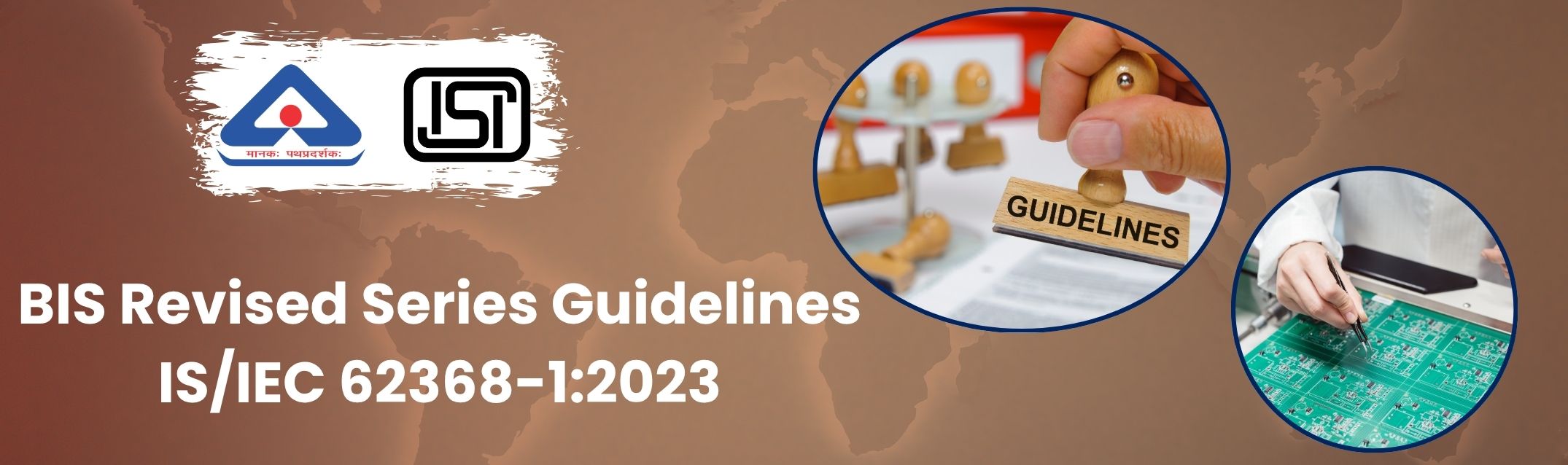
The Bureau of Indian Standards (BIS) has issued updated instructions defining how manufacturers must structure product series for testing and registration under the IS/IEC 62368-1:2023 safety standard.
These revised guidelines, released following the earlier October 2025 migration notification, provide clear and enforceable rules on product family formation, model grouping limits, and testing requirements under the BIS Compulsory Registration Scheme (CRS).
On 22 July 2026, BIS followed up with an official FAQ document clarifying the licence-administration side of this migration — covering licence number continuity, Standard Mark requirements, renewal timelines, testing obligations, and Critical Component List (CCL) compliance. This page has been updated to reflect those clarifications.
At Absolute Veritas, we assist electronics manufacturers, importers, and businesses with BIS CRS certification, documentation review, compliance management, and coordination with BIS-recognized laboratories across India.
Why BIS Issued These Revised Series Guidelines
In October 2025, BIS notified the migration of two widely used Indian safety standards — IS 13252 Part 1:2020 (covering IT equipment) and IS 616:2017 (covering audio and video equipment) — to the unified standard IS/IEC 62368-1:2023. While that notification clarified which standard applies, it left an important operational question unanswered: how exactly should manufacturers group multiple product variants into a single BIS registration?
Inconsistent series grouping had been a leading cause of BIS application objections, retesting requirements, and approval delays. These revised guidelines address that problem directly by setting precise criteria that manufacturers must follow when forming a valid product series.
The result is a more predictable, transparent, and efficient BIS certification process for businesses operating in India.
What Is a Product Family Under IS/IEC 62368-1:2023?
A product family, as defined under the revised guidelines, must be built around the maximum configuration of components and sub-assemblies. This means the most complex, highest-specification model in the group serves as the reference point for the entire series.
All models within the family must share:
- The same fundamental design and construction approach
- Common core components and parts
- Identical safety-related sub-assemblies and protective mechanisms
If any two products differ on these core characteristics, they cannot be grouped into the same series — regardless of how visually or commercially similar they appear.
8 Key Rules for BIS Series Grouping Under IS/IEC 62368-1:2023
Maximum Number of Models Per Series
A single series may include a maximum of 10 models, unless a higher limit is specifically permitted for a particular product category. One physical test sample must be submitted for every 10 models, and testing must always be conducted on the worst-case configuration — the model with the highest power demand, greatest complexity, or most safety-critical attributes.
IP Rating Consistency Across All Models
Every model in a series must carry the same IP (Ingress Protection) rating. IP testing must be conducted in BIS-recognised laboratories as per IS/IEC 60529. If IP protection is not claimed, no IP marking should appear on the product. When IP protection is used as a product safeguard, the applicable IP code must be declared in the product manual or equipment markings.
Enclosure Design Must Remain Consistent
Fire enclosure materials, electrical insulation barriers, and all protective housing elements must be identical across all models in a series. Minor dimensional differences are permitted only when safety clearances, ventilation integrity, and enclosure aperture distances from live internal parts remain uncompromised and consistent with IS/IEC 60529 requirements. Ventilation openings must be the same or more restrictive compared to the lead model.
Buttons, Controls, and Display Variations
Aesthetic or positional changes to buttons, controls, and displays are permitted only when they do not compromise product safety. Testing laboratories must formally confirm that any relocated controls do not reduce creepage distances, clearance distances, or fire enclosure integrity. Variations that cannot meet these criteria disqualify the models from being grouped in the same series.
Electrical Insulation Class Must Be Uniform
All models in a series must belong to the same electrical insulation class. The three permissible classes are: Class I (basic insulation with protective earth), Class II (double or reinforced insulation, no earth connection), and Class III (SELV supply). Mixing different insulation classes within a single series is not allowed under any circumstance.
Energy Source and Safeguard Classifications Must Match
All models must use the same energy source and safeguard system. ES (electrical), PS (power source), and TS (thermal source) classifications must remain identical across the series. Products with different energy source classifications cannot be grouped together. Additionally, active-cooled products (using fans) and passive-cooled products (using heatsinks only) must always be in separate series. Safety-critical components such as Y-capacitors, optocouplers, and MOVs must also remain identical across all models.
External Power Source and Battery Conditions
Products powered by an external energy source, those with an internal mains-connected power supply, and battery-operated devices cannot be grouped in the same series. Registered power adapters or power banks must be of equal or higher rating. USB-PD and PPS-compatible products may be grouped only when power negotiation limits are identical across all models. PCB and SMPS board layouts must be the same, and battery-operated devices must use the same battery chemistry, identical PCB layout, and the same charging and protection circuits. Only the highest-capacity battery model requires physical testing in BIS-accredited labs. All models in the series must share the same rated input voltage.
Additional Product Grouping Conditions
Beyond the technical criteria above, products in a series must also maintain similarity across the following attributes: form factor, presence of microphone and earphones, charging type, display type (devices with and without displays must be in separate series), touch or non-touch functionality, number of outputs and component ratings, frequency and phase configuration, largest paper size (for printing machines), types of mountings, processor enclosure design, and IP ratings of wireless transmitter/receiver systems. Smartwatches with and without SIM capability must always be placed in separate series.
Products That Must Always Be Registered Separately
Certain product differences are absolute boundaries under the revised guidelines. Regardless of how similar two variants appear commercially, the following differences always require separate BIS series registrations:
- Mains-operated vs battery-operated vs externally powered devices
- Active-cooled (fan) vs passive-cooled (heatsink-only) products
- Smartwatches with SIM vs smartwatches without SIM
- Products with a display vs products without a display
- Touch-enabled vs non-touch product variants
- Products with different energy source classifications (ES, PS, or TS)
- Products belonging to different insulation classes (Class I, II, or III)
- Products carrying different IP ratings within the same product line
Incorrect grouping of any of the above is one of the most common reasons for BIS application objections and retesting requirements — leading to unnecessary delays and additional costs.
Special Provisions and Flexibility Areas
The guidelines do allow some degree of flexibility in specific product categories:
- Power adapters, UPS units, inverters, and power banks may be grouped within a defined power or capacity range in a single series — providing practical flexibility for manufacturers managing large product portfolios.
- USB-PD and PPS-compatible products may be grouped only when power negotiation limits are strictly identical across all models in the group.
- Models with different battery capacities are permitted in the same series, provided the highest-capacity model is physically tested in a BIS-accredited laboratory.
Important: All notified components used inside a finished product must carry their own independent registration under the Component Registration Order (CRO). This is a separate compliance obligation and is not covered by the finished product's BIS CRS registration.
Effective Date and Who This Applies To
These revised series guidelines are effective immediately for all manufacturers, brand owners, and importers whose products are transitioning from IS 13252 Part 1:2020 or IS 616:2017 to IS/IEC 62368-1:2023 under the BIS CRS framework. There is no grace period — if you are currently submitting or preparing a BIS application, these rules govern your series structure right now.
Electronics and IT equipment covered under this update includes — but is not limited to — laptops, desktop computers, tablets, set-top boxes, routers, audio/video equipment, power adapters, UPS systems, wearables, and wireless communication devices.
Steps Businesses Should Take Before Sending Samples
Manufacturers and importers also play an important role in ensuring smoother BIS certification processing. Proper advance preparation significantly reduces the risk of objections, retesting costs, and market entry delays.
Businesses should ensure the following before submitting samples for testing:
- Audit all product variants against the 8 criteria outlined above
- Identify models that differ in power source, insulation class, IP rating, or cooling method — these must be separated into individual series
- Confirm that SMPS board layouts and transformer insulation designs are identical across all grouped models
- Verify that battery-operated devices share the same chemistry, PCB layout, and protection circuitry
- Ensure all internally used notified components carry independent CRO registrations
- Nominate the worst-case configuration as the designated test sample for each series
- Submit complete documentation — including CCL details, BIS-compliant labels, and finalized technical specifications — before sample dispatch
- Maintain active communication with your BIS-recognised testing laboratory throughout the process
Businesses that prepare thoroughly and structure their series correctly from the beginning consistently experience smoother BIS testing and faster certification timelines.
BIS FAQs on Migration – Licence, Renewal & Standard Mark Rules (22 July 2026)
On 22 July 2026, BIS issued a dedicated FAQ notification addressing the licence-administration questions manufacturers have raised since the October 2025 migration notification and the Series Guidelines above. While the Series Guidelines govern how models are grouped, this FAQ set clarifies what happens to your existing licence, renewal timelines, fees, and component compliance during migration to IS/IEC 62368-1:2023. For the full breakdown of all 15 clarifications, see our complete BIS Migration FAQ guide.
Licence Number (R-no.) Remains Unchanged
The existing Licence Number remains the same after successful migration to IS/IEC 62368-1:2023. Where a manufacturer holds separate licences for different product categories — for example, power adaptors for IT equipment versus power adaptors for audio/video equipment — each licence continues independently, and migration must be carried out separately for each licence.
Standard Mark Requirement
Products complying with IS/IEC 62368-1:2023 must bear the BIS Standard Mark as per Regulation 6 (Labelling and Marking Requirements) and Annexures I, II, and III of Scheme II, Schedule II of the BIS Conformity Assessment Regulations, 2018 — displayed as "IS/IEC 62368-1" with the R-number beneath the mark.
Laboratory Availability via LIMS
BIS-recognised laboratories for testing under IS/IEC 62368-1:2023 can be located through the BIS Laboratory Information Management System (LIMS) portal at lims.bis.gov.in, by searching the applicable Indian Standard number.
Renewal Under Old Standards Still Permitted
Licences due for renewal during the transition can still be renewed under IS 13252 (Part 1):2010 or IS 616:2017, up to 01 November 2028 — the last date of concurrent running notified by MeitY.
New Applications During Concurrent Running
Until 01 November 2028, applications may be processed under either the old standards or IS/IEC 62368-1:2023, provided applicants filing under the old standard give a declaration to implement the new standard by the cut-off date. Applicants are encouraged, though not mandated, to file directly under IS/IEC 62368-1:2023. Beyond 01 November 2028, no new licence will be granted under the old standards, and existing licensees who have not completed migration may face cancellation of licence and/or deletion of models from scope.
Adding New Models to an Existing Licence
New models tested under IS/IEC 62368-1:2023 may be included under an existing licence originally issued under the old standards, subject to Clause 4(C) of the Guidelines for Implementation of Migration dated 09 March 2026.
One Sample Per Licence Is Not Sufficient
Existing licensees must submit complete test reports from a BIS-recognised laboratory for all lead models in the licence scope — identified per the revised Series Guidelines — that were previously tested under IS 13252 (Part 1):2010 or IS 616:2017. A single representative sample per licence does not satisfy this requirement.
Handling End-of-Life (EOL) Lead Models
If a lead model has become end-of-life, it may be withdrawn from the licence by the licensee. The next appropriate lead model in the same series, identified per the MeitY Series Guidelines, may then be nominated to demonstrate compliance.
Separate Test Reports Per Manufacturing Location
Separate test reports are required for products manufactured at different manufacturing locations, since separate licences are granted per location under the Compulsory Registration Scheme (CRS).
Parallel Testing of Components and End Products
Components and end products notified under the Compulsory Registration Order (CRO) may be tested in parallel, in accordance with BIS's Guidelines on Parallel Testing — helping shorten overall migration timelines.
No Fee for Migrating Already-Registered Models
No fee is applicable for migration of already-registered models within the scope of licence, provided the application is filed via the Standard Revision provision available to existing licensees.
Critical Component List (CCL) Must Be Reassessed
Critical components complying only with IS 13252 (Part 1):2010 or IS 616:2017 cannot be accepted in the CCL after migration. As per Clause 4.1.2 of IS/IEC 62368-1:2023, components functioning as a safeguard must comply with the new standard itself, or with the safety aspects of the relevant IEC component standards where specified. Applicants may, however, register critical components and end products in parallel under the applicable BIS Parallel Testing Guidelines.
Testing Already-Marked Samples
Models already registered and bearing the BIS Standard Mark may still be submitted for testing under IS/IEC 62368-1:2023. The applicant must declare at submission that the model is already registered, and the laboratory must record this in the test report.
Pre-Application Testing Is Allowed
Manufacturers may begin testing to IS/IEC 62368-1:2023 before formally submitting their migration application, in line with the implementation and Series Guidelines.
How to Apply for Migration
Existing licensees apply through the Standard Revision / Amendment / Essential Requirement provision in their BIS CRS login, submitting complete test reports for all applicable lead models identified per the revised Series Guidelines, in accordance with the Guidelines for Implementation of Migration dated 09 March 2026.
Key Migration Dates at a Glance
- 09 March 2026 — Guidelines for Implementation of Migration to IS/IEC 62368-1:2023 issued
- 25 May 2026 — Revised Series Guidelines published for BIS CRS series grouping
- 22 July 2026 — BIS FAQ clarification on licence continuity, renewal, Standard Mark, and CCL compliance issued
- 01 November 2028 — Last date of concurrent running of IS 13252 (Part 1):2010 and IS 616:2017 alongside IS/IEC 62368-1:2023, per the MeitY implementation timeline. No new licences will be granted under the old standards beyond this date, and non-migrated licensees risk cancellation or model deletion.
Manufacturers are advised to plan lead-model testing well ahead of the 2028 deadline rather than waiting until the final months of the concurrent-running window, since retesting or objections can consume valuable time.
How Absolute Veritas Supports Businesses
Absolute Veritas provides professional support for BIS CRS certification, product testing coordination, documentation review, and compliance management services across India.
Our team assists businesses with:
- BIS CRS Certification Support under IS/IEC 62368-1:2023
- Product-Family and Series-Grouping Assessment
- Licence Migration Application Preparation (Standard Revision/Amendment)
- Documentation Verification and Preparation
- Label and Marking Compliance Review
- Technical Specification Assessment
- BIS-Recognised Laboratory Coordination
- Component Registration (CRO) Assistance and CCL Reassessment
- Pre-Submission Compliance Checks
- IS 13252 / IS 616 to IS/IEC 62368-1:2023 Migration Support up to the 2028 Deadline
We help manufacturers, importers, startups, and brands reduce compliance risks and avoid unnecessary testing delays during BIS approvals.
Need expert support for BIS CRS certification and series compliance under IS/IEC 62368-1:2023?
Connect with Absolute Veritas for professional guidance on BIS approvals, testing coordination, documentation review, and regulatory compliance support across India.
Frequently Asked Questions (FAQ)
What is IS/IEC 62368-1:2023 and why does it matter for BIS registration?
IS/IEC 62368-1:2023 is a unified Indian safety standard for audio/video, information, and communication technology equipment. BIS notified in October 2025 that products previously certified under IS 13252 Part 1:2020 and IS 616:2017 must now comply with this standard for BIS CRS registration in India.
How many models can be grouped in a single BIS series?
A maximum of 10 models can be included in one series under IS/IEC 62368-1:2023, unless a higher limit is specifically permitted for a given product category. One test sample is required for every 10 models, and testing must always be performed on the worst-case configuration.
Can battery-operated and mains-operated products be grouped in the same BIS series?
No. Battery-operated, mains-operated, and externally powered products must always be registered in separate BIS series. Grouping them together is one of the most common causes of BIS application objections and retesting delays.
Does migrating to IS/IEC 62368-1:2023 change my existing BIS Licence Number?
No. As clarified by BIS on 22 July 2026, the existing Licence Number (R-no.) remains the same after successful migration to IS/IEC 62368-1:2023, including where separate licences exist for different product categories. See our full migration FAQ guide for more details.
Can I still renew my licence under the old standard right now?
Yes. Renewal under IS 13252 (Part 1):2010 or IS 616:2017 is permitted up to 01 November 2028, the last date of concurrent running notified by MeitY.
What happens if I miss the 01 November 2028 migration deadline?
BIS may initiate cancellation of the licence and/or deletion of affected models from the scope of licence for licensees who fail to complete migration by the last date of concurrent running.
Why choose Absolute Veritas for BIS CRS compliance support?
Absolute Veritas provides end-to-end support for BIS CRS certification under IS/IEC 62368-1:2023 — including product-family assessments, series-grouping reviews, licence migration applications, documentation preparation, and laboratory coordination — helping manufacturers and importers avoid objections, retesting, and application delays across India.
Share this Post
 LinkedIn
  WhatsApp
  Facebook
 CONTACT US





 ❮
❮