Tel: 0129-4001010 Phone: +91 730 321 5033
Email: cs@absoluteveritas.com

BIS Registration 2026 for Audio Glasses (Wireless Earphones and Headphones): IS 13252 (Part 1):2010
Table of Content
- 1. Introduction
- 2. How Audio Glasses Ended Up in This Category
- 3. What IS 13252 (Part 1):2010 Actually Covers
- 4. Why the Standard You Pick Right Now Matters
- 5. Who Needs to Register
- 6. Getting the Product Definition Right
- 7. What to Do Before You Apply
- 8. About Absolute Veritas
- 9. Frequently Asked Questions (FAQ)
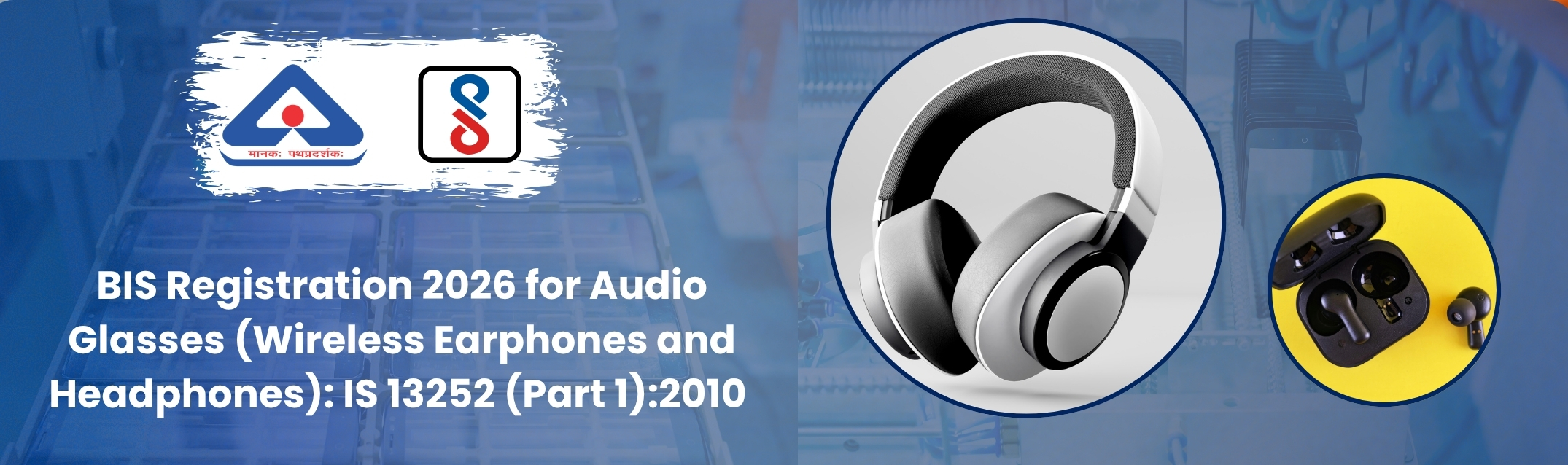
Audio glasses – the kind that look like ordinary spectacles but pack tiny speakers near your ears for calls and music – have quietly become a regulated product in India. BIS now treats them as a sub-type of Wireless Earphones and Headphones, which pulls them into the Compulsory Registration Scheme (CRS) and, for many applicants today, straight into the requirements of IS 13252 (Part 1):2010.
If you're building, importing, or private-labelling this category, the confusing part isn't the paperwork – it's figuring out which standard your product should actually sit under right now, since there's more than one live option. This piece works through where audio glasses fit, what IS 13252 (Part 1):2010 actually demands, and why the standard you pick today has consequences a couple of years out.
The category isn't hypothetical anymore either. Meta's Ray-Ban line has pushed camera-free "audio only" glasses hard through 2026, Amazon's Echo Frames have been in and out of the Indian market in earlier avatars, and Bose was an early mover with its now-discontinued Frames line. Closer to home, Indian audio brands such as boAt and Noise have been expanding aggressively into wearables and look like natural candidates to bring a similarly positioned product to market, given how quickly they've moved into neckbands, TWS earbuds, and smartwatches over the past few years. Any of them – or a private-label brand riding the same trend – would fall squarely inside this registration requirement the moment a qualifying product is sold in India.
How Audio Glasses Ended Up in This Category
This didn't happen through a dedicated notification for eyewear. BIS issued a classification circular on 13 August 2026 sorting a whole cluster of head-worn electronics – audio glasses, smart glasses, AR and MR glasses, VR headsets – into the product tables that already exist under the CRO 2021, rather than creating brand-new entries for each one. Audio glasses landed as a named product under the existing Wireless Earphones and Headphones listing.
The functional description BIS used is fairly broad: a device with Bluetooth or similar wireless connectivity, built-in microphones and speakers, support for calls and music playback, and in many cases an AI voice assistant riding along. If your product matches that description, in glasses form, it's covered – whether or not it also happens to take photos or record video.
One detail from the circular that trips people up: BIS is explicit that a licence granted for one named product doesn't automatically stretch to cover another. A company already registered for ordinary wireless earbuds cannot simply assume that licence extends to an audio-glasses line – each named product in the table needs its own registration. We've gone through the classification logic itself, including where smart glasses and AR/MR devices sit differently from audio glasses, in a separate breakdown of the wearable-glasses classification circular.
What IS 13252 (Part 1):2010 Actually Covers
IS 13252 (Part 1):2010 is India's general safety standard for information technology equipment – it isn't written specifically for audio products, which is exactly why it's been able to sit under so many unrelated categories over the years, from printers to set-top boxes to power adaptors.
| Requirement Area | What It Looks At |
|---|---|
| Electric Shock Protection | Insulation, earthing, and safe limits on accessible voltages and currents |
| Thermal and Fire Hazards | Temperature rise under normal and fault conditions, flammability of materials |
| Mechanical Strength | Resistance to impact, stress on enclosures and small parts |
| Battery and Power Source Safety | Safe charging behaviour and protection against battery-related faults |
| Markings and Instructions | Ratings, warnings, and user information printed on the product or packaging |
None of this is unique to earphones or glasses – it's the same baseline safety logic applied to almost any small electronic device with a battery and a circuit board. That's both the appeal and the catch, which the next section gets into.
Why the Standard You Pick Right Now Matters
Here's the part that actually needs a decision, not just a checklist. IS 13252 (Part 1):2010 isn't the only standard available to this category anymore. Back in October 2025, MeitY notified IS/IEC 62368-1:2023 as the newer safety standard for audio, video and similar electronic apparatus, and it's set to fully replace both IS 13252 (Part 1):2010 and the older IS 616:2017 once the transition period closes.
Until then – the cut-off currently sits at 1 November 2028 – a manufacturer can still register a wireless earphone, headphone, or audio-glasses product against either the older standard or the new one. After that date, only IS/IEC 62368-1:2023 will be accepted, and licences still running on the older standards will need to be re-certified or they lapse.
So the real question for an audio-glasses launch today isn't just "which standard am I allowed to use" – it's "which one makes sense given how long this product will be on shelves." If you already run a testing and documentation setup built around IS 13252 (Part 1):2010 for other IT-equipment products, sticking with it now can be faster and cheaper. If this is a genuinely new product line with years of runway ahead of it, going straight to IS/IEC 62368-1:2023 avoids paying for a re-certification cycle later. We've laid out that later deadline and what it involves in our IS 62368 certification guide.
Who Needs to Register
-
Manufacturers building audio glasses in India, whether standalone or as an extension of an existing wearables line
-
Importers sourcing finished audio-glasses units from overseas factories
-
Foreign manufacturers selling into India directly or through distributors, who will need an Authorised Indian Representative to hold the registration
-
Brand owners putting their own name on a product built by a contract manufacturer
A general overview of how CRS registration works end to end – documentation, testing, and the application itself – is covered in our BIS CRS certification guide, which is worth reading alongside this if CRS is new to your team.
Getting the Product Definition Right
This is where a lot of applications go sideways before testing even starts. "Audio glasses" is a specific product name in BIS's table, sitting under the wireless earphones and headphones category – it is not the same product name as "smart glasses," which typically adds a camera and photo or video capture, or "AR glasses," which layers in a display. Those sit in different rows of the same broader circular, with different classification logic.
If your product does more than play audio and take calls – say it also captures photos – don't assume the audio-glasses route covers you. Check the definition against what your device actually does before you file, since applying under the wrong product name is the kind of mistake that surfaces during review rather than at the start.
What to Do Before You Apply
-
Confirm your product's functions match the "audio glasses" definition rather than smart glasses or AR/MR variants
-
Decide between IS 13252 (Part 1):2010 and IS/IEC 62368-1:2023 based on how long this product will realistically stay in the market
-
Pull together design and circuit documentation for whichever standard you choose
-
Book testing at a BIS-recognised laboratory that covers the applicable standard
-
Appoint an Authorised Indian Representative if you manufacture outside India
-
File the CRS application under the correct, specific product name – not a broader earphone or headphone category
-
If you already hold a licence for a related wireless-audio product, don't assume it extends to audio glasses – check directly
About Absolute Veritas
Absolute Veritas is a leading Testing, Inspection, and Certification (TIC) consultancy with over 15 years of expertise, headquartered in New Delhi, India. We help manufacturers and importers of wireless audio products – including newer categories like audio glasses – work out the right classification, choose between IS 13252 (Part 1):2010 and IS/IEC 62368-1:2023, and carry a BIS CRS registration through testing, documentation, and approval.
Contact us today at cs@absoluteveritas.com or call +91-7303215033 for guidance on registering audio glasses or other wireless audio products under BIS CRS.
Frequently Asked Questions (FAQ)
Do audio glasses need BIS registration in India?
Yes. BIS classifies audio glasses as a named product under the Wireless Earphones and Headphones category, which falls within the Compulsory Registration Scheme.
Which standard applies to audio glasses – IS 13252 (Part 1):2010 or IS/IEC 62368-1:2023?
Both are currently valid options for wireless earphones and headphones, including audio glasses, until the transition period closes on 1 November 2028. After that date, only IS/IEC 62368-1:2023 will be accepted.
What does IS 13252 (Part 1):2010 actually check for?
It's a general IT-equipment safety standard covering electric shock protection, thermal and fire hazards, mechanical strength, battery safety, and required markings – not audio-specific testing.
Can one BIS licence cover both regular earphones and audio glasses?
No. BIS's August 2026 circular is explicit that separate licences are required for each named product, so an existing earphone or headphone registration does not automatically extend to audio glasses.
How are audio glasses different from smart glasses for BIS purposes?
Audio glasses are defined around wireless audio functions – calls, music, and voice assistants. Smart glasses and AR/MR glasses typically add cameras, photo or video capture, or displays, and are classified separately under BIS's 2026 wearable-glasses guidance.
Should a new product register under the older standard or the newer one?
It depends on how long the product is expected to stay in the market. A short product cycle may make IS 13252 (Part 1):2010 practical if the infrastructure already exists; a longer-life product is often better registered directly under IS/IEC 62368-1:2023 to avoid re-certification before 2028.
Share this Post
 LinkedIn
 WhatsApp
 Facebook
CONTACT US






 ❮
❮