Tel: 0129-4001010 Phone: +91 730 321 5033
Email: cs@absoluteveritas.com
BIS Extends IS 16102 (Part 1):2026 Implementation to 2 February 2027
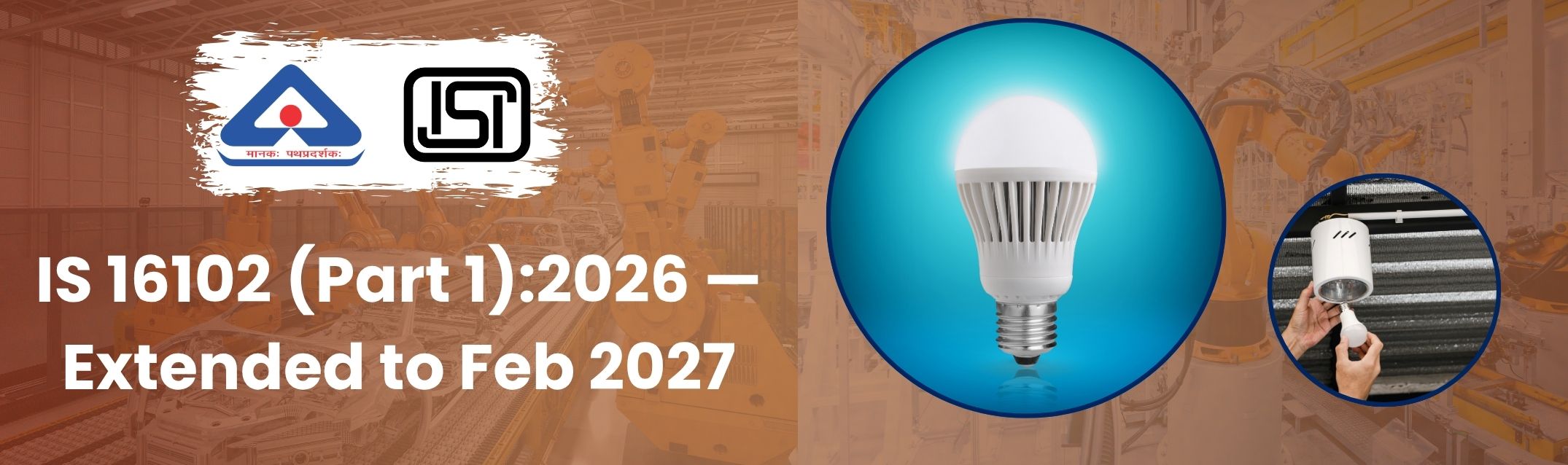
Table of Content
The Bureau of Indian Standards (BIS) has extended the implementation date of IS 16102 (Part 1):2026 – Self-Ballasted LED Lamps for General Lighting Services – Part 1: Safety Requirements (First Revision), giving manufacturers and importers additional time to prepare for the revised safety requirements.
As per the latest update, the implementation date has been extended to 2 February 2027. This revised standard is relevant to any business manufacturing, importing, or marketing applicable self-ballasted LED lamps in India, and BIS's current laboratory information already confirms that testing facilities are listing IS 16102 (Part 1):2026 in their scopes — the transition is well underway even though the enforcement date has moved.
What Actually Changed in the IS 16102 Implementation Timeline
The core update is straightforward: the implementation timeline for IS 16102 (Part 1):2026 has been pushed back. Here's the before-and-after:
| Particular | Details |
| Indian Standard | IS 16102 (Part 1):2026 |
| Product | Self-Ballasted LED Lamps for General Lighting Services |
| Standard Requirement | Safety Requirements |
| Revision | First Revision |
| Earlier Standard | IS 16102 (Part 1):2012 |
| Extended Implementation Date | 2 February 2027 |
| Relevant Businesses | Manufacturers, Importers & Brand Owners |
Manufacturers should not read the revision as a documentation-only change. The revised standard touches general test requirements, marking, mechanical strength, electrical safety, resistance to heat and flame, fault conditions, abnormal operation, and ingress protection — BIS's laboratory listings for the revised standard already show these testing areas in current scopes.
What Is IS 16102 (Part 1)?
IS 16102 (Part 1) specifies safety requirements for self-ballasted LED lamps intended for general lighting services. It's the standard that determines whether a given LED lamp is legally allowed to be manufactured, imported, or sold in India.
The comparison below shows how the revised edition differs from the standard it replaces:
| Aspect | IS 16102 (Part 1):2012 | IS 16102 (Part 1):2026 |
|---|---|---|
| Status | Earlier standard, being phased out | First revision, current requirement |
| Testing Scope | Based on older test methods and parameters | Updated across general, mechanical, electrical, thermal, and fault-condition testing |
| Lab Recognition | Existing scope at BIS-recognized labs | Already appearing in updated lab testing scopes |
| Compliance Deadline | Being superseded | Mandatory from 2 February 2027 |
Why This Extension Isn't a Reason to Wait
An extended deadline only helps if the extra time is actually used. BIS revises standards regularly, and the gap between "the rule changed" and "everyone actually complies" is usually where companies get caught out — either because testing takes longer than expected, or because a gap assessment turns up a product issue that wasn't obvious at first glance.
If you already hold BIS CRS registration for LED lamps, this is the moment to pull your existing documentation and check it against the 2026 revision — not wait for the deadline to force the issue. New applicants planning CRS registration for self-ballasted LED lamps should plan against the revised standard from the outset rather than the outgoing 2012 version.
Who Is Affected by This Update
Existing BIS CRS Registration holders for LED lamps should treat the extension as a working deadline, not a reason to relax — existing registrations and technical files need reviewing against IS 16102 (Part 1):2026 well before February 2027.
New applicants should plan any new BIS CRS Registration application for self-ballasted LED lamps directly against the revised 2026 standard.
Manufacturers and importers more broadly get a longer runway to review product designs, update test documentation, and coordinate testing without the risk of a supply disruption from an abrupt cutover.
What LED Lamp Manufacturers Should Do Now
-
Review IS 16102 (Part 1):2026 clause by clause against your current product specifications and test reports
-
Run a gap assessment to identify where existing documentation falls short of the revised requirements
-
Book testing slots with a BIS-recognized laboratory early, before deadline-driven demand builds up
-
Review and update existing CRS registration and supporting technical files where needed
-
Confirm product marking and labelling requirements are aligned with the revised standard
About Absolute Veritas
Absolute Veritas is a leading Testing, Inspection, and Certification (TIC) consultancy with over 15 years of expertise, headquartered in New Delhi, India. We help LED lamp manufacturers and importers manage the transition to IS 16102 (Part 1):2026 — from gap assessment against existing test reports, to coordinating with BIS-recognized laboratories, to managing CRS registration documentation and updates.
Contact us today at cs@absoluteveritas.com for expert guidance on your IS 16102 compliance planning.
Frequently Asked Questions (FAQ)
What is the new implementation deadline for IS 16102 (Part 1):2026?
BIS has extended the implementation date for IS 16102 (Part 1):2026, covering self-ballasted LED lamps for general lighting services, to 2 February 2027.
Does the extension mean compliance work can be delayed?
No. The extension provides more time to complete testing and documentation properly, not a reason to delay. Testing and certification activities can take time, particularly where product modifications or additional testing are required, so businesses should begin their compliance review well before the deadline.
How does IS 16102 (Part 1):2026 differ from the earlier 2012 standard?
The 2026 revision updates requirements across general test methods, marking, mechanical strength, electrical safety, resistance to heat and flame, fault conditions, abnormal operation, and ingress protection. BIS-recognized labs have already updated their testing scopes to reflect these changes.
Do existing BIS CRS Registration holders for LED lamps need to take action?
Yes. Existing registration holders should review their current products, test reports, and technical documentation against IS 16102 (Part 1):2026 to determine whether updates are needed for continued compliance.
Should new applicants apply under the old or the revised standard?
New applicants planning BIS CRS Registration for self-ballasted LED lamps should plan against the revised IS 16102 (Part 1):2026, since this is the standard that will be mandatory from 2 February 2027 onward.
Share this Post
 LinkedIn
 WhatsApp
 Facebook
CONTACT US
 ❮
❮