Tel: 0129-4001010 Phone: +91 730 321 5033
Email: cs@absoluteveritas.com

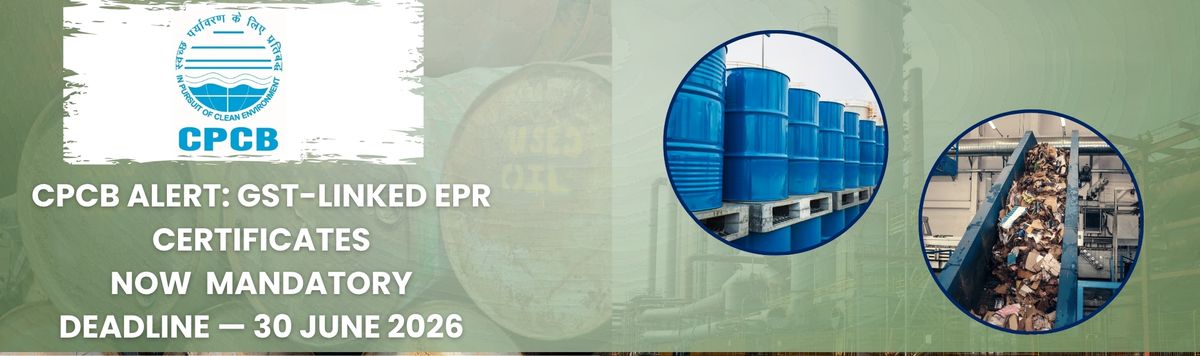
CPCB GST Linked EPR Certificates for Used Oil: What Businesses Must Know Before 30 June 2026
Table of Content
Introduction
India's push toward responsible waste management has been gaining serious momentum. One of the more significant steps in that journey was the introduction of an Extended Producer Responsibility (EPR) framework specifically for used oil a move that placed accountability squarely on the shoulders of both those who recycle it and those who produce it.
Since April 2024, this system has been operational. Recyclers earn EPR Certificates through the CPCB's Used Oil EPR Portal. Producers buy those certificates to meet their regulatory obligations. On paper, it works. In practice, though, questions around the authenticity of certain certificates have been difficult to ignore.
The Central Pollution Control Board (CPCB) has now decided to address that head on with a hard deadline of 30 June 2026.
What Has the CPCB Actually Changed?
The board's latest directive is straightforward: going forward, an EPR Certificate is only as good as the invoice behind it and that invoice must be GST linked.
This might sound like a minor administrative update, but the implications run deeper than they appear. Until now, there was limited ability to cross-verify whether a recycler's claimed sales were genuine. GST e-invoicing changes that entirely. Every transaction leaves a traceable digital footprint. Linking EPR Certificates to that footprint makes the system far harder to manipulate.
For businesses operating with full transparency, this is welcome news. For those whose documentation has not been airtight, this is a wake up call.
Here is a clear summary of what has been mandated:
-
GST Linked Invoices Are Now Mandatory: Recyclers generating EPR Certificates must ensure that all sales of recycled products are documented through GST-compliant invoices. Certificates will only be treated as valid when backed by verifiable, GST linked sales transactions.
-
Mandatory GST E-Invoicing Registration: Recyclers who have not yet adopted GST e-invoicing are directed to register immediately. Failure to do so may result in loss of eligibility to generate EPR Certificates on the Used Oil EPR Portal.
-
Non Compliant Certificates May Constitute a Regulatory Violation: CPCB has explicitly stated that EPR Certificates generated using non GST linked invoices after the 30 June 2026 deadline may be treated as false or invalid and classified as non compliance under the Hazardous and Other Wastes (Management and Transboundary Movement) Second Amendment Rules, 2023.
-
Producers Bear Responsibility Too: Producers registered under the EPR framework must verify that all recycled products procured from used oil recyclers are supported by GST linked sales e-invoices. Accepting non compliant certificates may expose producers to direct compliance risk.
Who Does This Apply To?
Used Oil Recyclers
Your ability to generate EPR Certificates after 30 June 2026 depends entirely on whether your sales invoices are connected to GST e-invoicing. If they are not, those certificates will not be considered valid. The CPCB has made clear that invalid certificates generated after the deadline could be treated as false documentation and flagged as non-compliance under the 2023 Amendment Rules. The consequences of that classification are not trivial getting ahead of this now is far less painful than dealing with it later.
Producers
Your responsibility does not end at purchasing certificates. You are now expected to verify that the EPR Certificates you procure are backed by GST compliant invoices from your recycler. If they are not, the compliance risk does not stay with the recycler alone it flows upstream to you as well. Reviewing your procurement and due diligence practices is no longer optional.
Also Read: EPR COMPLIANCE FOR WASTE TYRE
Key Implementation Dates
With 30 June approaching faster than most businesses realise, the time to audit your processes is now not next month.
| Event | Date |
|---|---|
| EPR Framework Operational | 1 April 2024 |
| Compliance Deadline for GST E-Invoicing | 30 June 2026 |
| Non-Compliant Certificates Lose Validity | 1 July 2026 Onwards |
Pre-Deadline Compliance Checklist
If any of these answers are uncertain, that is exactly where to start.
For Recyclers:
- Is your GST registration current and active?
- Have you set up GST e-invoicing for your recycled product sales?
- Can every EPR Certificate you have generated be matched to a compliant invoice?
- Have you built proper documentation practices into your ongoing processes?
- Have you reviewed all existing records before the 30 June 2026 deadline?
For Producers:
- Have you verified the compliance status of the EPR Certificates currently in your possession?
- Are your recycler partners issuing GST linked invoices for all recycled product sales?
- Does your procurement team know what documentation to look for before accepting a certificate?
- Have you strengthened your internal due diligence procedures for EPR compliance?
WHY USE ABSOLUTE VERITAS (AV) FOR EPR COMPLIANCE?
Absolute Veritas is a leading private sector organisation in India, specialising in Inspection, Testing, Audits, Certification, and Consulting services across industries in India and worldwide. With deep expertise in regulatory compliance, Absolute Veritas helps manufacturers, importers, recyclers, and producers achieve higher standards of quality, efficiency, and regulatory readiness.
Regulatory shifts like this one rarely announce themselves with enough lead time. By the time most businesses take notice, the deadline is uncomfortably close. At Absolute Veritas (AV), we help compliance teams and business owners cut through the complexity reviewing where your documentation stands, identifying gaps before they become violations, and putting practical systems in place that keep your business on the right side of the rules.
We handle end-to-end EPR compliance support from GST e-invoicing alignment reviews and documentation audits to EPR registration advisory and ongoing regulatory guidance. We do not believe compliance has to be overwhelming. With the right guidance, it does not have to be.
For any questions regarding EPR compliance for Used Oil or other waste categories, please reach out to us via email at cs@absoluteveritas.com
EPR BLOGS

CHANGES TO LOGIN CREDENTIALS ON PORTAL FOR PLASTIC PACKAGING
The Ministry of Environment, Forest & Climate Change has noted changes in the login details...
Read More
EXTENSION FOR SUBMITTING ANNUAL RETURNS FOR BATTERY PRODUCERS
The Ministry of Environment, Forest & Climate Change has issued a notification in response...
Read More
EPR COMPLIANCE FOR WASTE TYRE
India annually discards approximately 275,000 tyres without a comprehensive disposal strategy, while an additional...
Read More-min.png)
EPR FOR USED OIL
The Ministry of Environment, Forest and Climate Change (MoEFCC) under the Central Government has released a draft...
Read More
EPR COMPLIANCE IN INDIA
India faces a significant challenge with its daily production of thousands of tonnes of plastic waste, exacerbated...
Read More
EPR AUTHORIZATION IS MANDATORY FOR GAS ANALYZER
Gas analyzers are crucial instruments used to analyze the composition of gases across various applications...
Read More
EPR AUTHORIZATION IS MANDATORY FOR DRILLS
Drills are versatile tools used in DIY projects, construction, and various industries to create holes...
Read More
EPR AUTHORIZATION IS MANDATORY FOR SAWS
Saws are essential tools for cutting materials across various industries and woodworking applications...
Read More
EPR AUTHORIZATION FOR SEWING MACHINES
In the textile and apparel sectors, sewing machines are indispensable for stitching fabrics and crafting...
Read More
EPR AUTHORIZATION FOR COIN SLOT MACHINES
Coin-operated slot machines are commonly found in gambling and entertainment venues, offering patrons...
Read More
Filing Deadline Extension for E-waste (Management) Returns
Registered Producers and Recyclers under the E-waste (Management) Rules, 2022, are hereby informed...
Read More
EPR CERTIFICATION CONSULTANT IN INDIA
Extended Producer Responsibility (EPR) is a crucial regulation in India, ensuring that companies manage...
Read More<
>
FREQUENTLY ASKED QUESTIONS
What is the CPCB's new GST requirement for EPR Certificates?
The CPCB has mandated that all EPR Certificates generated by used oil recyclers must be backed by GST linked sales invoices. From 1 July 2026, certificates generated without GST e-invoicing compliance will not be considered valid and may be treated as false documentation under the Hazardous and Other Wastes (Management and Transboundary Movement) Second Amendment Rules, 2023.
Who is affected by this new CPCB directive?
Both used oil recyclers and producers are affected. Recyclers must ensure their sales invoices are GST linked before generating EPR Certificates. Producers are responsible for verifying that the EPR Certificates they procure are backed by GST compliant invoices from their recycler partners.
What is the deadline for GST e-invoicing compliance under the EPR framework?
The deadline is 30 June 2026. From 1 July 2026 onwards, any EPR Certificate generated using non-GST-linked invoices will be deemed invalid. Businesses are strongly advised to complete their GST e-invoicing setup and documentation review well before this date.
What happens if a recycler does not comply by 30 June 2026?
If recyclers continue to generate EPR Certificates using non GST linked invoices after the deadline, those certificates may be treated as false or invalid. This could result in non-compliance classification under the Hazardous and Other Wastes (Management and Transboundary Movement) Second Amendment Rules, 2023, which carries significant legal and regulatory consequences.
What is the EPR framework for used oil in India?
The Extended Producer Responsibility (EPR) framework for used oil was introduced through the Hazardous and Other Wastes (Management and Transboundary Movement) Second Amendment Rules, 2023, notified on 18 May 2023 and effective from 1 April 2024. Under this framework, used oil recyclers generate EPR Certificates through the CPCB portal, and producers fulfil their regulatory obligations by purchasing those certificates.
How can Absolute Veritas help with EPR compliance for used oil?
Absolute Veritas provides end-to-end EPR compliance support — including GST e-invoicing alignment reviews, documentation audits, EPR registration advisory, and ongoing regulatory guidance. Our team helps recyclers and producers identify compliance gaps and put the right systems in place before regulatory deadlines. Contact us at cs@absoluteveritas.com to get started.
Share this Post
 LinkedIn
  WhatsApp
  Facebook
 CONTACT US




 ❮
❮