Tel: 0129-4001010 Phone: +91 730 321 5033
Email: cs@absoluteveritas.com

Footwear QCO Amendment Orders, 2026: Exemption Extended to 31 July 2027 & New 4,500-Pair R&D Import Allowance
Published Date: 27 July 2026
Table of Contents
- 1. Overview
- 2. What the Amendment Orders Change
- 3. Extended Exemption Period: 31 July 2027
- 4. New Research & Development Import Allowance
- 5. Conditions Attached to the 4,500-Pair Exemption
- 6. Which Footwear QCOs Are Amended
- 7. What This Means for Manufacturers, Importers, and Brands
- 8. Steps Businesses Should Take Now
- 9. Common Mistakes to Avoid
- 10. How Absolute Veritas Supports Businesses
- 11. Frequently Asked Questions
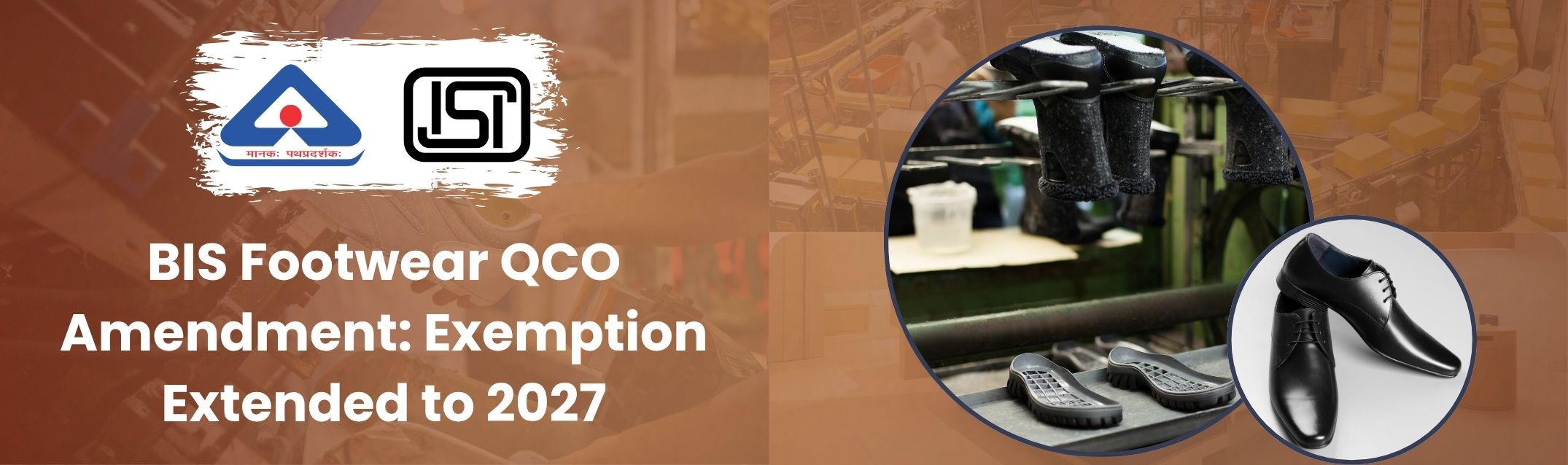
If your business manufactures, imports, or sells footwear in India, two recent amendment orders are worth building into your compliance planning. The Department for Promotion of Industry and Internal Trade (DPIIT), Ministry of Commerce and Industry, has notified amendments to both footwear Quality Control Orders (QCOs) — published in the Official Gazette on 12 June 2026 as S.O. 3037(E) and S.O. 3038(E).
Many businesses have been working toward BIS certification for footwear under these QCOs — including moulded plastics footwear and lined/unlined polyurethane boots — and factors like product testing timelines, multiple product variants, factory approvals, and supply chain challenges can make the process time-consuming. These amendments extend the compliance runway and open a narrow, conditional route for importing footwear for research and development purposes.
At Absolute Veritas, we work with footwear manufacturers, importers, and brands on BIS certification, QCO compliance, and regulatory coordination across India — here's exactly what these two amendment orders mean for you.
Overview
Both footwear QCOs — Footwear made from All Rubber and All Polymeric Material and its Components (Quality Control) Order, 2024 and Footwear made from Leather and Other Materials (Quality Control) Order, 2024 — originally came into force on 15 March 2024 and were previously amended on 30 August 2024. Each order carried a proviso exempting certain goods from compliance up to a fixed date.
The two new amendment orders, issued under Section 16(1) and (2) read with Section 25(3) of the Bureau of Indian Standards Act, 2016, following consultation with the Bureau, make identical changes to each of the two principal orders: they push the exemption deadline forward by a year, and they carve out a new, conditional allowance for R&D imports.
What the Amendment Orders Change
| Provision | Details |
|---|---|
| Exemption Deadline Extended | The compliance exemption date in clause 2 of both principal QCOs is extended from 31 July 2026 to 31 July 2027. |
| New R&D Import Allowance | A new proviso permits import of up to 4,500 pairs of footwear or related articles per year by manufacturers of leather and footwear products, for research and development and non-commercial use — without requiring compliance under the respective QCO, subject to conditions. |
| Standard Mark Still Mandatory Otherwise | Outside this narrow exemption, footwear covered under either QCO must still conform to the applicable Indian Standard and carry the BIS Standard Mark. This is a targeted carve-out, not a general relaxation. |
| Applies Identically to Both QCOs | Both amendment orders — for rubber/polymeric footwear and for leather/other-material footwear — make the same two changes, worded near-identically. |
Extended Exemption Period: 31 July 2027
One More Year of Compliance Runway
Businesses that were working against the earlier 31 July 2026 deadline now have until 31 July 2027 before the underlying exemption in clause 2 of both QCOs lapses. This gives manufacturers and importers additional time to complete testing, factory approvals, and BIS Scheme-I or Scheme-II licensing without the immediate compliance pressure of the earlier date.
New Research & Development Import Allowance
Up to 4,500 Pairs a Year, Without QCO Compliance
Manufacturers of leather and footwear products can now import up to 4,500 pairs of footwear or related articles in a year for the purposes of research and development and non-commercial use, without needing to meet the QCO's certification requirements for that batch. This is intended to support activities such as evaluating materials or components and validating designs ahead of commercial production — the gazette text itself is limited to “research and development and non-commercial use,” so businesses should apply the allowance strictly within that scope rather than reading it more broadly.
Conditions Attached to the 4,500-Pair Exemption
This allowance is not unconditional. Goods imported under it must meet all of the following:
- Must not be sold commercially
- Must be marked and embossed with the words ‘NOT FOR SALE’
- May be disposed of only as scrap
- The manufacturer must maintain year-wise records of goods imported under this provision, and furnish them to the Government as and when required
These conditions apply identically under both amendment orders. Businesses relying on this route should treat the marking and record-keeping requirements as strictly as the quantity cap itself — failure on either front removes the basis for the exemption.
Which Footwear QCOs Are Amended
| Amendment Order | Amends | Gazette Ref. | Date |
|---|---|---|---|
| Footwear made from All Rubber and All Polymeric Material and its Components (QC) Amendment Order, 2026 | Footwear made from All Rubber and All Polymeric Material and its Components (QC) Order, 2024 | S.O. 3037(E) | 12 June 2026 |
| Footwear made from Leather and Other Materials (QC) Amendment Order, 2026 | Footwear made from Leather and Other Materials (QC) Order, 2024 | S.O. 3038(E) | 12 June 2026 |
Both principal orders originally came into force on 15 March 2024 (S.O. 1422(E) and S.O. 1421(E) respectively) and were previously amended on 30 August 2024.
Official Source Documents
This article is based on the official notifications published by the Department for Promotion of Industry and Internal Trade (DPIIT), Ministry of Commerce and Industry.
Gazette Notification – S.O. 3037(E), dated 12 June 2026 (Rubber/Polymeric Footwear):
Gazette Notification – S.O. 3038(E), dated 12 June 2026 (Leather Footwear):
What This Means for Manufacturers, Importers, and Brands
- An extra year (to 31 July 2027) to complete BIS certification without the earlier deadline pressure
- A narrow, legitimate route to bring in limited quantities of footwear for R&D and evaluation, without triggering full QCO compliance for that batch
- Continued obligation to fully certify any footwear intended for commercial sale in India
- An expectation of clean record-keeping if the R&D allowance is used, since the Government can request year-wise records at any time
Understanding these changes early can help avoid last-minute disruptions, import delays, and supply chain issues once the QCOs become fully applicable to your product range.
Steps Businesses Should Take Now
- Confirm which of the two footwear QCOs applies to your product range — rubber/polymeric or leather/other materials
- Review your current BIS certification timeline against the new 31 July 2027 deadline
- If you plan to import samples for R&D, confirm your annual volume will stay within the 4,500-pair cap
- Set up a year-wise record-keeping process for any goods imported under the R&D allowance before you start importing
- Ensure 'NOT FOR SALE' marking and embossing is built into your sample/prototype process from the outset
- Keep progressing full BIS certification in parallel — this allowance does not extend to commercial goods
Common Mistakes to Avoid
- Assuming the R&D import allowance covers commercial samples or pre-launch stock intended for eventual sale — it doesn't; goods must not be sold commercially under any circumstance
- Treating the 4,500-pair figure as a per-shipment limit rather than an annual cap across all R&D imports
- Skipping the 'NOT FOR SALE' marking and embossing requirement, which is a condition of the exemption, not a suggestion
- Not maintaining year-wise records from the start, then trying to reconstruct them if the Government asks
- Treating the extended 31 July 2027 deadline as a reason to delay starting BIS certification rather than as additional working time
How Absolute Veritas Supports Businesses
Absolute Veritas provides end-to-end support for footwear manufacturers, importers, and brands navigating these QCO amendments, including:
- BIS Certification for Footwear — leather, rubber, and polymeric categories
- Compliance timeline planning against the revised 31 July 2027 deadline
- Guidance on structuring R&D import documentation, marking, and year-wise record-keeping
- BIS Certification Support for Importers
- FMCS – Foreign Manufacturer Certification Services
- Regulatory liaison and DPIIT/BIS notification tracking
Need help planning your footwear compliance timeline or structuring an R&D import under these amendments?
Connect with Absolute Veritas for professional guidance on BIS certification, QCO compliance, and regulatory coordination across India.
Frequently Asked Questions (FAQ)
What do the Footwear QCO Amendment Orders, 2026 change?
They extend the compliance exemption deadline in both footwear QCOs from 31 July 2026 to 31 July 2027, and add a new allowance to import up to 4,500 pairs of footwear per year for research, development, and non-commercial use, subject to conditions.
Which footwear QCOs are affected?
Both the Footwear made from All Rubber and All Polymeric Material and its Components (QC) Order, 2024, and the Footwear made from Leather and Other Materials (QC) Order, 2024, are amended — via S.O. 3037(E) and S.O. 3038(E) respectively, both dated 12 June 2026.
Can imported R&D footwear be sold in India?
No. Goods imported under the 4,500-pair R&D allowance must not be sold commercially, must be marked and embossed 'NOT FOR SALE', and may only be disposed of as scrap.
Is the 4,500-pair limit per shipment or per year?
It is an annual cap — up to 4,500 pairs of footwear or related articles per year, per manufacturer, under the conditions specified in the amendment.
Does this exemption remove the need for BIS certification on commercial footwear?
No. Footwear intended for commercial sale must still conform to the applicable Indian Standard and carry the BIS Standard Mark. The exemption applies only to the specific R&D/non-commercial import allowance and the extended compliance deadline.
What records must manufacturers keep under the R&D allowance?
Manufacturers must maintain year-wise records of goods imported under this provision and furnish them to the Government as and when required.
How can Absolute Veritas help with footwear QCO compliance?
Absolute Veritas supports footwear manufacturers, importers, and brands with BIS certification planning, compliance timeline management against the revised deadline, and guidance on structuring R&D import documentation correctly.
Note: This content is for guidance only. In case of any inconsistency, the Bureau of Indian Standards Act, 2016, the applicable Quality Control Orders, and the amendment orders S.O. 3037(E) and S.O. 3038(E), both dated 12 June 2026, shall prevail.
BIS BLOGS
.png)
Guide to BIS CRS Registration for Products in India
The Bureau of Indian Standards (BIS) and its Compulsory Registration Scheme (CRS) play a vital role in ensuring the quality...
Read More.png)
BIS Registration Renewal: A Complete Guide
The BIS CRS (Bureau of Indian Standards/Compulsory Registration Scheme) outlines mandatory requirements for both domestic...
Read More
BIS CRS Labelling Guidelines
Under the BIS-CRS Labelling Scheme, which currently covers 78 mandatory product categories, all products must receive...
Read More%20Compliance%20Needed%20for%20Analog%20CCTV%20Cameras.png)
No Essential Requirement Compliance Needed for Analog CCTV Cameras
As per recent notification dated 12th March 2025, the Ministry of Electronics and Information Technology (MeitY) has...
Read More
Updated BIS Implementation Guidelines for IS 61683 Standard
The Bureau of Indian Standards (BIS) has released revised implementation guidelines for IS 61683, the Indian Standard...
Read More
BIS Implements IS 16270 for Solar PV Batteries
The Bureau of Indian Standards (BIS) has released updated implementation guidelines for IS 16270:2023, a crucial standard...
Read More
Share this Post
 LinkedIn
  WhatsApp
  Facebook
 CONTACT US






 ❮
❮